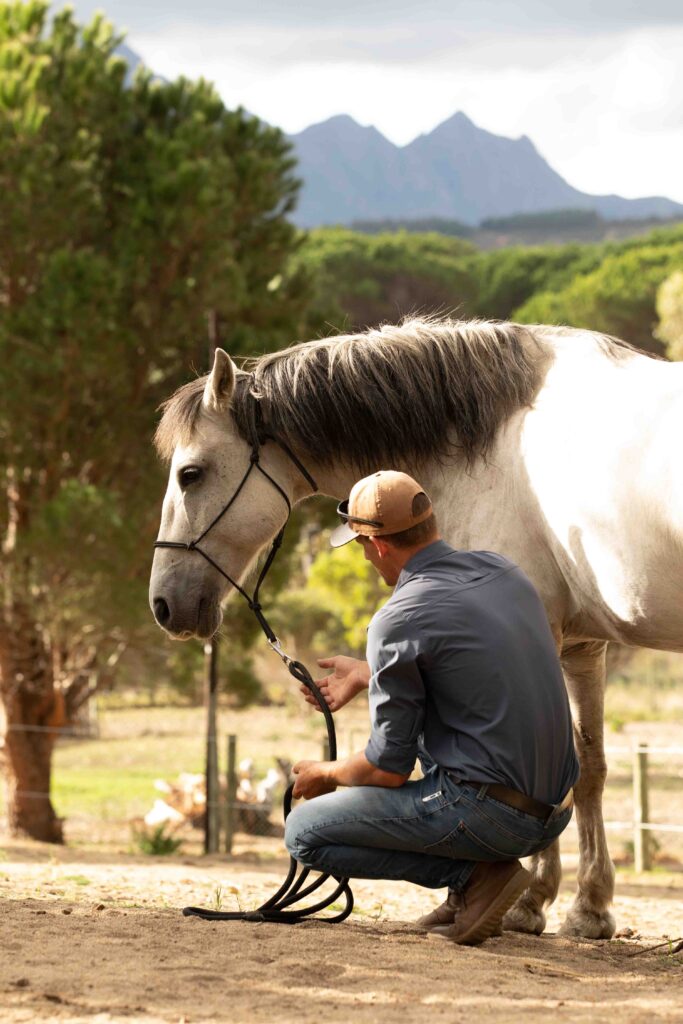
MEET RYNHARDT ERASMUS (RAY)
Childhood
At nine, I had two horses on the farm. The first was an Arab — steady, patient, forgiving of mistakes. We rode through farmland, jumped logs, swam in dams. He taught me what easy looks like. The second was a stallion. He lived on the same farm. Unhandled. Mature. The kind of horse adults stayed away from. He wasn’t brought in for me. He was just there, and I was a child, and at some point I started spending time with him. Whatever I did with the Arab, I did with him. Lead him. Brush him. Tack him up. Ride him. Out into the same fields, over the same logs, into the same dams. And it worked. Not because I had technique — at nine, I had nothing technique-like. Possibly because I had no agenda except honesty. A child who hasn’t been taught how to manipulate a horse can’t manipulate one. He can only ask. The stallion seemed to register that, and answered. I didn’t have language for what I was doing. I’m still working on the language for it now. But the question that started in those fields — what is the horse responding to, when he says yes to a child with nothing to teach him? — has shaped everything since. Around the same period, I started trimming my own horses’ hooves. There was no farrier close enough, and a chronically long hoof was a chronic problem. So I borrowed a knife and a rasp, watched a few times, and started. I broke things and learned. I read whatever I could find. The hooves taught me a different lesson, in a different language: what you see on the surface is downstream of structure underneath. Both horses, both questions, the same instinct — pay attention to what’s actually there.
The Bush Years
I qualified as a field trails guide young — [ specifics to fill: youngest in the country / region / specific qualification body ]. The walking work taught me to read environments before I had a horse underneath me to filter them. Wind, ground, sound, animal posture. Walking safaris across [ specific reserves to fill in ].
After a few years of that, I missed the horses. Walking gave me proximity to ground; it didn’t give me partnership. So I went looking for the work that combined both — and found Big Five horseback safaris. South Africa and Botswana, [ specific reserves to fill in ]. I qualified as a Big Five horseback guide and worked it for [ duration to fill in ].
Riding lions and elephants is not a horsemanship clinic. It’s a stress test of every assumption you’ve ever made.
A horse on a safari ride has to function in environments designed to make him want to flee. He must hold steady when the wind shifts, when something moves in the brush, when an elephant bull steps out twenty metres ahead and decides to assess whether you’re a threat. The horse you ride into that scenario is not the horse you ride at home.
Why does a horse stand in front of an elephant — and then buck at a show?
A horse on a safari ride will hold steady through a lion charge. Two days later in an arena, in front of a small crowd, the same horse can come apart. The triggers don’t compare. The risks don’t compare. The biology doesn’t change between the bush and the arena. So what changes?
Lately I’ve started to think the answer is partly in the rider.
In the bush, the rider has no second chance. There is no other horse to swap to. There is no version of the situation in which the horse “isn’t listening” and the answer is to find a different one. The rider has to be present, honest, and committed because the alternative is unsurvivable. The horse reads that, and rises.
In an arena, the rider has options. If the horse “isn’t listening,” maybe the saddle is wrong, maybe the warm-up was off, maybe this horse just isn’t the right one. The rider has a way out. So does the horse — by failing the rider’s expectations and being replaced.
The bush teaches honesty because dishonesty has consequences. The arena teaches the opposite, slowly, by removing them. Most of the trouble I see in modern horsemanship comes from that erosion.
That insight is what the work is built around now.
Riding lions and elephants is not a horsemanship clinic. It’s a stress test of every assumption you’ve ever made.
A horse on a safari ride has to function in environments designed to make him want to flee. He must hold steady when the wind shifts, when something moves in the brush, when an elephant bull steps out twenty metres ahead and decides to assess whether you’re a threat. The horse you ride into that scenario is not the horse you ride at home. And the difference is not training — it’s regulation.
The bush taught me that calmness under intense provocation is not the absence of stimulus. It’s the presence of a regulated nervous system. A horse that is appearing calm but is internally loaded will fail in those moments. A horse that is genuinely regulated will move through them. The difference is invisible in a safe arena. In the bush, it’s the difference between coming home and not.
The Integration
After enough years of horse work, I knew I had hit the ceiling of what observation alone could explain. I had answers I trusted, but I couldn’t always say why. That’s not a position you stay in long if you’re serious. I went looking for the science. I found three bodies of work that, together, explained almost everything I’d seen. Dr Andrew McLean’s equitation science gave me the learning theory — how horses actually acquire and retain behaviour, the difference between operant and classical conditioning, the cost of inconsistency. Jaak Panksepp’s affective neuroscience gave me the regulation framework — the seven core emotional systems all mammals share, and what it actually means when we say a horse is “stressed” or “calm.” Yogi Sharp’s hoof biomechanics gave me language for what I’d been doing with the rasp at thirteen — the structural reasons a horse stands, moves, and carries himself the way he does. Underneath all of it, Xenophon — writing in the fourth century BC — had already described the central principle: what you ask of the horse, the horse should be able to give willingly. I built the 4D Model to hold all of this in one frame. Two dimensions of observable horse work; a third for nervous-system regulation; a fourth for the temporal patterns that link them. I wrote Communicate With Your Horse to put the 7-Step Framework on paper.