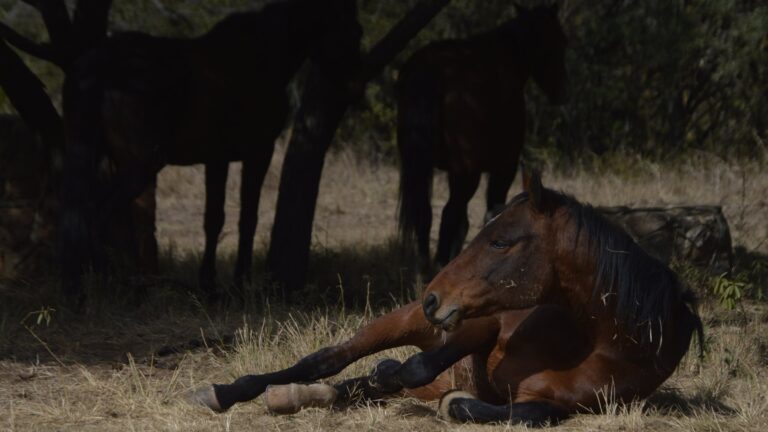
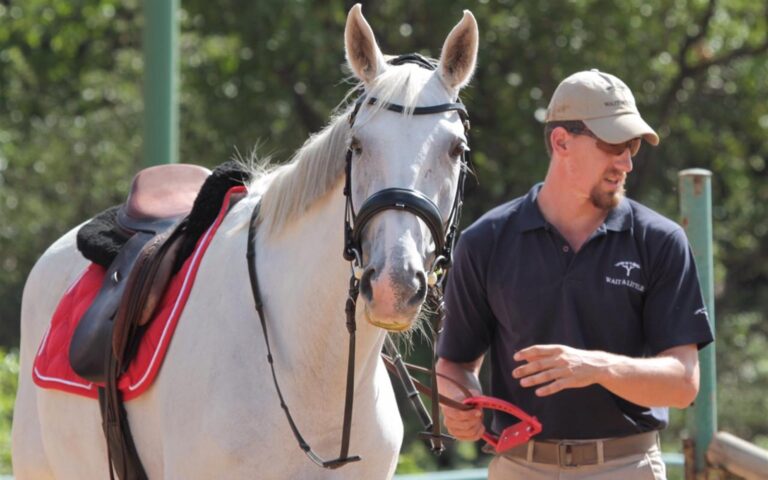
Why the rope
can't win.
Your horse weighs six or seven times what you do. At anything faster than a walk, no arm on earth can hold him. So what is really happening at the end of a tight lead rope, inside his body and inside yours, and why does pulling harder make it worse? The physics, the physiology and the way through, with every claim graded.
Contents — 9 sections
The 30-second version
- You cannot out-pull a horse. On grass you can hold about 300 to 500 newtons before your boots slide. A half-tonne horse beats that by leaning back, and at a canter he carries about 9,000 joules of movement. Stopping that with your best pull would take about 15 metres, and only if he stopped pushing.
- So when a rope works, it works as a signal. The pressure is unpleasant and the release is what teaches. That is learning, not mechanics.
- Pressure the horse cannot end builds a brace outside and an alarm inside. Head up, neck stiff, back dipped, weight back; noradrenaline and adrenaline in seconds, cortisol over the next half hour. A horse in that state learns worse.
- Your body is part of the message. Your nerves, your speed and even your smell reach him alongside the rope.
- The way out is never a stronger pull. Stop adding, change the direction, release the smallest try, and wait for the inside to catch up with the outside.
The horse controls his feet. He always did. Good training earns the wish to give them.
How to read the badges
Every claim carries a grade, so you always know how much weight it can bear.
- Proven in horses: shown in horse studies that are repeated, large, or standard physiology.
- Shown in horses: at least one good horse study; needs repeating.
- Other animals: well established in other mammals, not measured in horses.
- Likely: follows from the studies here, but nobody has tested it directly.
- Argued: the studies or experts disagree.
- Physics: arithmetic you can check yourself. The inputs are stated estimates.
- Our practice: what we do and see work in our own horses. Honest, useful, not yet tested scientifically.
01The physics: a contest you cannot win
What you can pull
When you pull on a rope while standing, the limit is rarely your strength. It is your boots. You can only pull along the ground as hard as the ground will hold you before you slide, and that is roughly your body weight multiplied by the grip of your soles. A 75 kg person weighs about 735 newtons. On grass or an arena surface the grip is perhaps 0.4 to 0.7 of that, so you can hold about 300 to 500 newtons before your feet start to go. Leaning back with good footing, a strong person might reach 500 to 1,000 newtons for a few seconds.
Nobody has measured handlers pulling on lead ropes that we could find, so these are estimates from basic mechanics, not lab figures.
What the horse can pull
A 500 kg horse weighs about 4,900 newtons. Leaning that weight back against the halter costs him almost nothing and can put well over a thousand newtons into the rope. If he spooks and goes from standing to 5 metres a second in one second, that start alone takes 500 × 5 = 2,500 newtons, and a frightened horse can start harder than that. He also has four feet on the ground and a low, wide base. You have two.
scroll →
So why does a rope ever work?
Because the horse lets it. When a horse steps forward to a light feel, your few newtons did not move his half-tonne. They made a pressure on his poll and nose that he finds unpleasant, and he has learned that stepping forward is what makes it stop. That is negative reinforcement: taking away something unpleasant strengthens whatever the horse did just before it went away. It is the learning principle behind most handling and riding.
Even when force appears to work, it is working as information, not as mechanics. The rope is a telephone line, not a winch.
A telephone line carries whatever you put down it: a light, clear question, or a braced, frightened shout. The rest of this article is about what happens when it carries the shout.
The one place leverage does matter
A sideways pull on the head can bend the neck and turn the horse, and a turned horse cannot keep running straight at full power. This is the idea behind the one-rein stop. It works through the horse's own balance and his willingness to follow his nose, not by beating his mass, and at speed a sharp bend can bring a horse down. We found no study that tested it. Treat it as an emergency tool taught early at a walk, not as training.
02The brace: what the body does when the rope goes tight
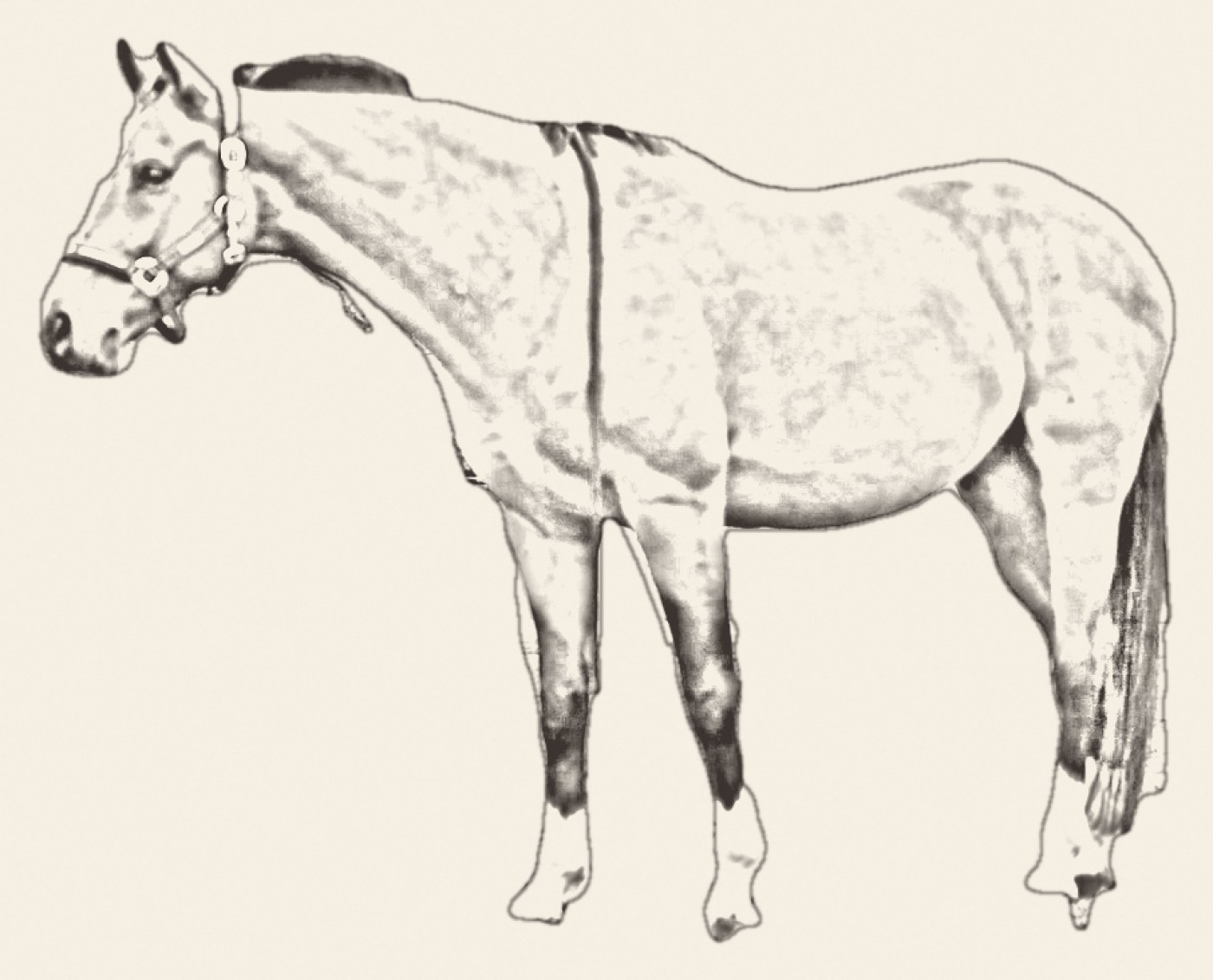
Soft on the rope
- 1
- 2
- 3
- 4
- 5
Braced against it
- 1
- 2
- 3
- 4
- 5
- 6
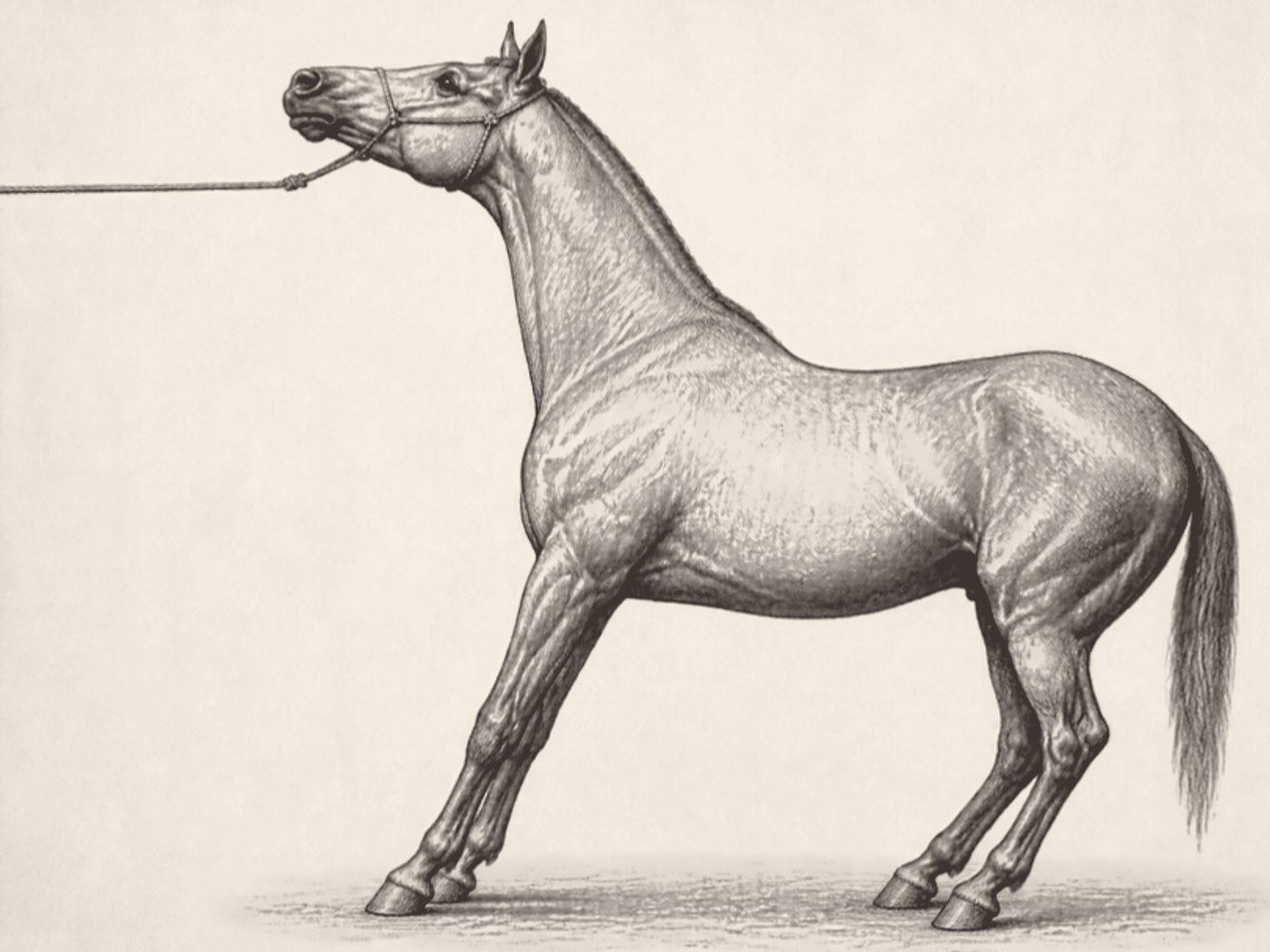
About the right-hand drawing: none of our own footage shows a horse setting back on a rope (our horses are not handled that way), so it was drawn for this article and checked against equine anatomy: knees and hocks bending the right way, four planted hooves, a halter and rope as they really sit. It shows a posture, not a particular horse.
What the studies say about each piece
- More pressure, longer pressure, more resistance with the head. Twenty horses were trained to step back from a pull on the reins, with the handler beside them. Head, neck and mouth evasions became more common as the tension went up and as the signal lasted longer. Horses that did something other than step back took longer to answer and met more tension [1]. The brace is not stubbornness. It rises with the pressure itself.
- A forced head carriage goes with stress. Horses lunged with the neck held raised showed more conflict behaviour, a shift toward the alarm side in their heart rhythm, and higher saliva cortisol 5 and 30 minutes afterwards [2]. Ridden horses held in hyperflexion, the opposite extreme, had higher blood cortisol than in a normal working position [3], and a review of 58 studies concluded that forcing a head position harms welfare however it is done [4]. The common thread is a forced posture, either way.
- Head up changes the back. In seven dressage horses on a treadmill, raising the head and neck dipped the front of the back, bent the loins the opposite way, and shrank the back's normal swing. A very high head also shortened the stride at walk [5].
- The "opposition reflex". Many trainers say horses are born with a reflex to push into pressure. It is a fair description of what you see, but we found no study that has tested it as a reflex. What the research shows is more ordinary: a postural brace that grows with the pressure, plus whatever this horse has learned about ropes before.
Why the brace defeats the pull
A braced horse has organised his whole body to resist one direction: the line of the rope. Weight back, legs set against that line, neck a stiff strut. Pulling harder along that same line meets him exactly where he is strongest. You are adding to the very thing he is built, in that moment, to resist. That is why the way out (section 7) is almost always a change of direction, not a change of force.
03The chemistry, second by second
scroll →
The first seconds: the nerves
- The alarm side of the nervous system fires. Its nerve endings release noradrenaline straight onto the heart, blood vessels and muscles, and the heart rate climbs within a few beats. A resting adult horse's heart beats about 28 to 44 times a minute.
- The adrenal glands release adrenaline into the blood within seconds. A review of horse studies found adrenaline rises markedly when exercise carries a strong emotional content [6].
- The spleen contracts. A horse's spleen holds a large reserve of red blood cells, and adrenaline squeezes them into the circulation to carry more oxygen for flight. It is why an excited horse's blood count can read high.
- Sugar is released, the gut slows, the pupils open, muscle tone rises. The body is being made ready to run.
- In the brain, a small cluster of cells spreads noradrenaline that sharpens attention to threat and narrows everything else. Nobody can measure this in a working horse's brain [7], so in horses it is likely rather than proven.
The next minutes: the hormones
The second system is slower. The brain signals the pituitary gland, the pituitary sends a hormone called ACTH into the blood, and ACTH tells the adrenal glands to make cortisol. Cortisol takes minutes to climb and stays up for longer; in horses lunged in a forced, raised head position it was still higher 30 minutes after the session [2].
The numbers, honestly
No study has measured cortisol during a lead-rope pulling match, so any figure for that would be invented. Here is what the nearest studies did measure:
- Ridden horses in hyperflexion: blood cortisol about 176 nmol/L, against about 158 nmol/L in a normal working position, roughly 11 percent higher [3].
- Lunged horses in a raised, fixed head position: saliva cortisol significantly higher at 5 and 30 minutes after work than in other positions [2].
- Hard exercise raises cortisol and adrenaline too, and that is normal physiology, not distress [8]. A rise in cortisol on its own does not mean harm.
What matters most: control, and what it does to learning
Forty-one horses were split three ways: some were ridden first, some were put through a stressor they could not control, and some did nothing. Then all of them learned a pressure-and-release task. The exercised horses learned fastest, and their cortisol fell while they learned; in the other groups it rose. The horses with the highest cortisol needed the most attempts to learn [7].
Put that next to section 2. A horse in a pulling match is under pressure he cannot end by anything he knows how to do. That is what an uncontrollable stressor is. So the pulling match does two things at once: it builds the brace on the outside, and it creates the inside state in which the horse learns least.
04Two kinds of stuck
The brace: stuck and loud inside
Head high, eye hard, nostrils tight or flared, neck stiff, weight set back, ears pinned on you or flicking hard. Heart rate up, alarm running. He is not shut down. He is fully switched on and resisting. He needs the pressure to stop growing, a different direction to answer in, and a release the instant he tries (section 7).
The shutdown: stuck and quiet inside
Head level or low, neck flat, eyes and ears fixed rather than soft, little interest in anything around him. He can look calm, lazy or well behaved. Then, under real challenge, he can react suddenly and big.
Researchers who watched 59 working horses in their home stables found about one in four standing like this, in what they called a withdrawn posture. Those horses were less interested in their surroundings but reacted more emotionally in harder situations, and their blood cortisol was lower, not higher [10]. A later study linked low cortisol to other signs of poor welfare, including back problems [11], and withdrawn horses ate less of a sweet treat, a sign of lost pleasure [12].
There is a related idea called learned helplessness: an animal that learns nothing it does can end something unpleasant stops trying. It was first shown in dogs and rodents. Researchers have argued that horses handled with pressure that never releases could go the same way, though it has not been demonstrated in horses [13].
The worst case is not the horse whose cortisol is high. It is the one whose system has gone flat, and who now looks easy.
He needs no more pressure. Small questions he can get right, and that pay off, so answering becomes worth doing again; a reward he values, such as food or a scratch at the withers, helps. And a vet and a back check, because pain sits behind many of these horses [11].
| The brace | The shutdown | |
|---|---|---|
| Head | High, pulling back | Level or low, fixed |
| Eye | Hard; white may show | Dull or staring |
| On the rope | Resists more as it tightens | Barely responds, or late |
| Inside | Alarm running | Gone flat; can flip to explosive |
| Cortisol | Rising | Can be lower than normal over time |
| Wrong move | Pull harder | Mistake it for calm and ask more |
| Right move | Change direction, release the try | Small, rewarding questions; vet check |
scroll →
05Your body is on the rope too
What has been shown
- Your expectation changes his heart. People leading or riding a horse past an umbrella were told it would open. It never did. Their heart rate went up, and so did the horses' [16].
- Heart rhythms are linked, both ways. Measuring person and horse together, researchers found that changes in one heart rhythm predicted changes in the other, in both directions. Which one led depended on what they were doing and how well they knew each other [17].
- A familiar person settles him more. Horses groomed by familiar handlers shifted further toward the rest side of the nervous system than with strangers [18].
- Fear has a smell. Horses with sweat collected from frightened people at their nostrils startled harder and had higher peak heart rates than with sweat from happy people [20].
- Speed matters most. In a study of how people approach horses, a fast approach sent ponies off at a trot and further away. Direction and body posture mattered much less [21].
- They read where you are looking from your body, head and eyes [24], and given a free choice, horses walked up to a person in a slumped, quiet posture rather than a tall, square one [23]. for attention, for posture.
What has not been shown
That a person can deliberately switch off a horse's alarm by "aligning" their nervous system with his. The coupling that has been measured is a statistical link, not a dial you can turn, and every route with evidence behind it runs through what he can see, hear, smell and feel.
The rope mirror: six checks on yourself
None of these has been tested one by one in a study; they come from the findings above and from our own work.
- Hands. Is there a loop of slack in the rope between asks? A rope that is always a little tight is a question that never ends.
- Arm. Is your elbow soft, or locked? A locked arm sends your whole body's stiffness straight to his poll.
- Breath. Breathe out before you ask. A held breath is a held body, and he can see and feel it.
- Speed. Are you moving at his speed, or faster? Speed is the best-supported lever we have [21].
- Eyes. Soft eyes on where you are going, or a hard stare at his head?
- Release. Does the pressure end at the moment he tries, or when you get round to it?
For your own body, slow breathing with a longer out-breath is well proven in people to settle the heart rhythm. Whether your slow breath directly settles the horse has not been tested.
06Heavy aids: what they cost
The same rules apply to a lead rope, a rein, a bit or a leg. The studies below used reins on a halter or a bridle, in hand and under saddle.
- More tension, held longer, brings more evasion. Head, neck and mouth evasions rose with both the size and the length of the rein signal [1].
- The equipment changes the answer, not the rule. In the same horses, a bridle got faster answers to lighter signals than a halter, but also more head, neck and mouth evasions [1]. A sharper tool makes the signal stronger; it does not make the pressure fairer.
- Forced positions cost welfare, however they are made. Across 58 studies of hyperflexion, how the position was imposed made no difference to the welfare concern [4].
- Forcing can quiet a horse without winning him. Foals given forced handling sessions were less reactive later, but they did not seek out people any more than untouched foals, and their blood markers suggested lower welfare [22]. Quiet is not the same as willing.
- The size of the ask can halve in one session. When the pressure ended the moment the horse stepped back, the tension needed fell by about half within eight tries [14].
- Timing is the teacher. When riders released before the horse had begun to answer, the horse took longer to respond on the next try [15]. A release that comes too early teaches nothing; a release that comes late teaches that answering does not pay.
Pressure asks the question. The release is what teaches the answer.
07What unlocks a braced horse
Because the brace is set against one line, the way through is to ask for something the brace is not set against. This sequence is our method. It is built on the proven learning principle in section 6 and the mechanics in section 2, but the exact steps have not been tested in a study.
- Read which stuck it is. Head high and pulling back: the brace. Head low, fixed, dull: the shutdown (section 4). The steps below are for the brace.
- Stop adding. Hold a steady feel, or soften it. Breathe out. Unlock your elbow.
- Move to the side of his shoulder and ask his nose to come a little toward you, so that a front foot has to move to keep his balance. A step to the side is a step he can take without "losing" the tug-of-war he thinks he is in.
- Release on the smallest try. A shift of weight, a softening at the poll, a foot lifted. Not a full step: the start of one.
- Wait. Give the inside time to catch up with the outside [9]. Look for the head lowering, a breath out, the eye softening, a blink.
- Ask forward again, lighter than before.
- If he is about to run, let go before he does. Your 500 newtons will not stop him, and a rope wrapped round a hand can break it. The only stop that works is the one you taught at a walk, before he left.
- Write it down in the Horse Flow app: what he braced at, what unlocked him, how long his head took to come down. Next time, start below that line.
For the shutdown horse: do not add pressure. Ask for something tiny and easy, reward it, finish soon, and book a vet and a back check before the next session.
08Authority, redefined
Put the pieces together. The physics says you cannot hold a horse who has decided to go, and that at speed you lose by a long way. The learning research says that even when the rope works, it works as a signal the horse chooses to answer, and the release is what teaches. The physiology says that pressure he cannot end builds a brace outside and an alarm inside, that the alarm makes him learn worse, and that pushed long enough it can flatten him into a horse who looks quiet and is not. The coupling studies say your own state reaches him through every sense he has.
So what is authority? Not the ability to make a horse do something. Nobody has that, and the numbers show it. Authority is setting up the conditions in which his nervous system can afford to say yes, and then making yes the thing that ends the question.
- You control the size of the question. Small enough that he can answer it.
- You control the timing of the release. At the try, every time.
- You control the speed of everything. Slow.
- You control your own state. Down before you ask him to be.
- You control the direction. When he braces against one line, offer another.
That is why "negotiation" is the right word, understood properly. It does not mean bargaining, or letting the horse decide everything. It means a conversation in which the horse's answer actually changes what happens next. A question he cannot answer is not a negotiation. It is a pulling match, and Plate 1 shows how that ends.
Words we use, and words we don't
Some popular words sound scientific and are not, or point at the wrong thing. This is the honest list.
| Often said | We say | Why |
|---|---|---|
| "Righting reflex" | The brace | The righting reflexes turn a falling body the right way up. They are not about rope pressure. |
| "Opposition reflex" | The brace, which grows with pressure | Never tested as a reflex. What is shown is resistance rising with tension and time [1]. |
| "Frozen" or "immobilised" | Braced, or shut down | Two different states that need opposite handling. One word for both hides the danger. |
| "Cortisol spike" | An alarm response | A cortisol rise is normal physiology. Withdrawn horses can have low cortisol [10,11]. |
| "Neural resonance" | Your state is part of the signal | Heart rhythms are linked [17], through the senses, not by resonance. |
| "Dominance" | Influence over movement | The pull does not win, and the release does the teaching. |
09Your next step
See it on real horses
At a Horse Flow clinic we work through this on your own horse: reading the brace and the shutdown, the rope mirror, and the change of direction that unlocks a planted horse. The free webinars go deeper into the science.
See clinics and webinars →The Horse Flow app
Log what your horse braced at and what unlocked him, session by session, and watch the line move. The HFA Compass scores the foundation the brace is built on: standstill, locomotion, and Turn & Go.
Get the app →The horse controls his feet. He always did. Good training earns the wish to give them.
✓The evidence, claim by claim
| Claim | Source | Grade |
|---|---|---|
| A person can hold about 300–500 N before their feet slide; a horse beats this by leaning back | Basic mechanics, stated estimates | |
| Stopping a cantering horse with a 600 N pull needs about 15 m | Energy of movement ÷ force | |
| Release of pressure teaches the response (negative reinforcement) | Learning theory; [14,15] | |
| Head, neck and mouth evasion rises with tension and its duration | [1] | |
| Forced head positions raise stress markers and harm welfare | [2–4] | |
| Raising the head dips the front of the back and reduces its swing | [5] | |
| An inborn "opposition reflex" | No test found | |
| Adrenaline rises markedly with emotionally charged effort | Review [6] | |
| Higher cortisol goes with slower learning; uncontrollable stress impairs it | [7] | |
| Heart rate stays up after the visible reaction stops | [9] | |
| Withdrawn horses: less responsive, more reactive under challenge, lower cortisol | [10–12] | |
| Learned helplessness in horses | Review [13] | |
| Rein tension needed halves within one session when released at the try | [14] | |
| Releasing before the response slows the next response | [15] | |
| A nervous handler raises the horse's heart rate | [16] | |
| Horse and human heart rhythms are coupled both ways | [17,19] | |
| Familiar handlers shift horses toward rest | [18] | |
| Human fear odour raises horses' startle and heart rate | [20] | |
| Fast approach matters more than direction or posture | [21] | |
| Forced handling quiets foals without improving their bond with people | [22] | |
| Horses read human attention and prefer a quiet posture | [23,24] | |
| A person can switch off a horse's alarm by "aligning" nervous systems | No evidence found | |
| The change-of-direction sequence for a braced horse | Our method |
scroll →
§References
- Eisersiö, M., Byström, A., Yngvesson, J., Baragli, P., Lanatà, A. & Egenvall, A. (2021). Rein tension signals elicit different behavioral responses when comparing bitted bridle and halter. Frontiers in Veterinary Science.↩1↩2↩3↩4↩5
- Smiet, E. et al. (2014). Effect of different head and neck positions on behaviour, heart rate variability and cortisol levels in lunged Royal Dutch Sport horses. The Veterinary Journal.↩1↩2↩3↩4
- Zebisch, A. et al. (2013). Effect of different head–neck positions on physical and psychological stress parameters in the ridden horse. Journal of Animal Physiology and Animal Nutrition.↩1↩2↩3
- König von Borstel, U. et al. (2024). Hyperflexing the horse's neck: a systematic review and meta-analysis. Scientific Reports.↩1↩2↩3
- Gómez Álvarez, C.B. et al. (2006). The effect of head and neck position on the thoracolumbar kinematics in the unridden horse. Equine Veterinary Journal Supplement, 36, 445–451. doi↩1↩2
- Ferlazzo, A. et al. (2020). The different hormonal system during exercise stress coping in horses. Veterinary World.↩1↩2
- Henshall, C. et al. (2022). The effect of stress and exercise on the learning performance of horses. Scientific Reports.↩1↩2↩3
- Hennes, N. et al. (2025). Exploring the association between stress-related hormonal changes, behaviours and facial movements after an interval training exercise in French Standardbred. PLoS ONE.↩
- Christensen, J.W., Rundgren, M. & Olsson, K. (2006). Training methods for horses: habituation to a frightening stimulus. Equine Veterinary Journal.↩1↩2↩3
- Fureix, C. et al. (2012). Towards an ethological animal model of depression? A study on horses. PLoS ONE.↩1↩2↩3
- Pawluski, J. et al. (2017). Low plasma cortisol and fecal cortisol metabolite measures as indicators of compromised welfare in domestic horses (Equus caballus). PLoS ONE.↩1↩2↩3↩4
- Fureix, C. et al. (2014). Investigating anhedonia in a non-conventional species: do some riding horses Equus caballus display symptoms of depression? Applied Animal Behaviour Science.↩1↩2
- Hall, C., Goodwin, D., Heleski, C., Randle, H. & Waran, N. (2008). Is there evidence of learned helplessness in horses? Journal of Applied Animal Welfare Science, 11(3), 249–266. doi↩1↩2
- Eisersiö, M. et al. (2021). A rein tension signal can be reduced by half in a single training session. Applied Animal Behaviour Science.↩1↩2↩3
- Eisersiö, M. et al. (2025). What is reinforced? The timing of the release of rein tension and the horse's response latency for trot to walk transitions. Applied Animal Behaviour Science.↩1↩2↩3
- Keeling, L.J., Jonare, L. & Lanneborn, L. (2009). Investigating horse–human interactions: the effect of a nervous human. The Veterinary Journal.↩1↩2
- Callara, A.L. et al. (2024). Unveiling directional physiological coupling in human-horse interactions. iScience.↩1↩2↩3
- Scopa, C. et al. (2020). Inside the interaction: contact with familiar humans modulates heart rate variability in horses. Frontiers in Veterinary Science.↩1↩2
- Wienhold, S. et al. (2025). The relationship of early life adversity and physiological synchrony within the therapeutic triad in horse-assisted therapy. Journal of Neural Transmission.↩
- Jardat, P. et al. (2026). Human emotional odours influence horses' behaviour and physiology. PLoS ONE. doi↩1↩2
- Birke, L. et al. (2011). Horses' responses to variation in human approach. Applied Animal Behaviour Science.↩1↩2↩3
- Pereira-Figueiredo, I. et al. (2024). Forced handling decreases emotionality but does not improve young horses' responses toward humans and their adaptability to stress. Animals.↩1↩2
- Smith, A.V. et al. (2017). Domestic horses prefer to approach humans displaying a submissive body posture rather than a dominant body posture. Animal Cognition.↩1↩2
- Proops, L. & McComb, K. (2009). Attributing attention: the use of human-given cues by domestic horses. Animal Cognition. doi↩1↩2