Back to basics:
the nervous system.
How important is it, really, to understand your horse's nervous system? More important than any technique you will ever learn. Every behaviour, every posture, every heartbeat and every left-or-right preference your horse shows is the output of one system. Here is how it works — in plain language first, and in full depth for anyone who wants it.
Skim mode — headlines, In-short boxes and plates only.
The 30-second version is below.
Contents — 8 sections
The 30-second version
- Everything your horse does is the nervous system at work. It notices, judges and responds — usually before anything we would call thinking. Behaviour, posture and physiology are three readouts of that one process.
- The horse's state decides what it can learn. A calm, attentive horse learns what you are teaching. A frightened horse mostly learns what to be afraid of.
- Posture runs both ways. The nervous system shapes how the body is held, and how the body moves feeds straight back into the nervous system. Slow, precise movement is one of the few tools that works on both directions at once.
- Left and right preferences are real and wired into the brain. They are normal. A sudden or growing one-sidedness is not stubbornness — it is information, and often it means stress or pain.
- Pain is the hidden driver behind many "behaviour problems". Rule it out before you train.
Horse Flow Academy doesn't change what you do with your horse. It changes the state your horse does it in.
How to read the evidence badges
Every scientific claim in this article carries a grade, so you always know how much weight it can bear.
- Strong — consistent findings across several controlled studies or systematic reviews, or established textbook physiology.
- Moderate — good-quality studies, but few of them, small samples, or mostly one research group.
- Limited — a single small study, conference data, or an early association that hasn't been tested further.
- Absent in horses — the mechanism is well established in other mammals (usually rodents or humans) but has not been measured in horses.
- HFA field observation — what we see consistently in our own work. Useful, honest, and not yet tested scientifically.
01Everything starts here
Picture a horse grazing. At the edge of the field a plastic bag lifts in the wind. In a fraction of a second, three things happen at once. The head comes up and the ears lock on — that is behaviour. The neck and back tighten and the weight shifts back, ready to move — that is posture. The heart rate climbs and the breathing changes — that is physiology. The horse hasn't "decided" anything yet. Its nervous system has already detected, judged and prepared.
That one scene is the whole argument of this article. The nervous system isn't one topic among many in horsemanship. It is the layer everything else sits on. The hoof matters because of what it tells the nervous system about the ground. The saddle matters because of what it tells the nervous system about the back. The training method matters because of what it teaches the nervous system to expect. Feed, housing, companions and the person holding the rope all arrive in the same place.
Built to notice first. The horse is a prey animal, and its whole nervous system is organised around one priority: detect danger early and move before it arrives. Its eyes sit on the sides of the head, giving an almost all-round view — roughly 350 degrees — with a narrow strip in front where both eyes overlap and small blind spots directly in front of the nose and directly behind. For most of the horse's evolutionary history, the individual that paused to examine the movement in the grass didn't leave descendants. The one that moved first did.
Perceive, evaluate, respond. Everything your horse does runs through the same loop (Plate 2). It perceives something, evaluates it — safe or not, familiar or new, does this predict comfort or discomfort — and responds. Then it feels its own response, and that feeds back into what it perceives next. Training can act on every stage: we change what the horse perceives (how and from which side we present things), how it evaluates (what it has learned predicts safety and release) and which response pays off (what earns the release).

- 1Brain — detects, judges and decides. Includes fast threat circuits that act before "thinking" does.
- 2Spinal cord — the main cable. Runs reflexes on its own and relays everything else to and from the brain.
- 3Peripheral nerves — sensory nerves bring information in from skin, muscles, joints and hooves; motor nerves carry commands out to muscles.
- 4Autonomic system — runs heart, breathing, gut, sweat and saliva automatically: the accelerator and the brake.
- 5Gut nervous system — a network in the gut wall that runs digestion and talks to the brain in both directions.
- 6Hoof receptors — touch, pressure, vibration and pain receptors in the hoof. Every footfall is information.
↺ Feedback: the horse feels its own body — and that becomes part of what it perceives next.
The science in depthThe map — four parts of one system
Central nervous system — the brain and spinal cord. The brain integrates everything; the spinal cord is the main cable, and it also runs simple reflexes on its own.
Peripheral nervous system — sensory nerves carrying information in from the eyes, ears, nose, skin, muscles, tendons, joints and hooves, and motor nerves carrying commands out to the muscles.
Autonomic nervous system — the automatic control of heart rate, breathing, digestion, sweating, pupil size and saliva. It has two branches. The sympathetic branch mobilises the body for action; the parasympathetic branch slows it down, digests, repairs and restores. They are not an on/off switch: both are active all the time, and what changes is the balance between them.
Enteric nervous system — a dense network of nerve cells in the wall of the gut that runs digestion locally and communicates with the brain in both directions.
Standard veterinary anatomy and physiology, conserved across mammals.
The science in depthWhy the fast route wins
In the mammals studied in most detail — rats, primates and people — signals about a possible threat reach the amygdala (the brain's threat-detection hub) by a short, fast route, before the slower route through the cortex delivers a detailed picture [1]. The fast route trades accuracy for time: a hundred false alarms cost less than one missed predator.
The horse brain has the same structures — amygdala, hypothalamus, brainstem, cerebellum and cortex — but the timing of these routes has not been measured in horses.
for the mechanism in other mammals · for direct horse measurement.
What it means in practice: you cannot reason a horse out of a fast-route response in the moment. You can only change what that route learns over time, and help the horse recover more quickly when it fires.
02The accelerator and the brake: physiology
Think of a car with the accelerator and the brake both partly pressed at all times. The accelerator — the sympathetic branch — raises the heart rate, quickens the breathing, sends blood to the big muscles, pauses digestion, dries the mouth and widens the pupils. The brake — the parasympathetic branch — slows the heart, restarts digestion and brings saliva back. Neither is "good" or "bad". A horse needs both. What we call regulation is how smoothly a horse moves between them, how far it can be pushed towards the accelerator while still listening, and how quickly it comes back to baseline afterwards.
Soft eye with normal blinking, ears moving between you and the surroundings, steady breathing, head at or slightly below the withers, mobile jaw.
What's happening insideBrake and accelerator balanced; attention available.
Capacity to learnHighest. This is where training belongs.
Two waves of stress chemistry. When a horse gets a fright, the first wave arrives within seconds: adrenaline and noradrenaline, released by nerves and by the adrenal glands. That's the jolt — the leap sideways, the snort. The second wave is slower. The brain signals the pituitary gland, the pituitary signals the adrenal glands, and the adrenals release cortisol. In mammals, cortisol typically peaks somewhere around 15 to 30 minutes after a stressor and takes considerably longer than that to clear.
That timing matters more than most people realise. The horse that spooked at the gate can look settled two minutes later while still being chemically primed. A second scare inside that window doesn't start from zero — it lands on top of the first (Plate 4). This is why some horses seem fine for most of a session and then "suddenly" fall apart: it wasn't sudden.
You are part of the equation. In a Swedish study, people led or rode horses up and down the same 30-metre line four times. Before the fourth pass, the handlers were told an umbrella would be opened as they went by. It never was. Yet on that pass, the handlers' heart rates rose — and so did the horses' [2]. The horses had no way of knowing about the umbrella. They were reading the human. The study didn't identify exactly what the horses picked up on — grip, breathing, muscle tone, the way the person moved — but the message is plain: your nervous system is one of the signals your horse's nervous system is monitoring.
What you can read from the ground. An adult horse at rest has a heart rate of roughly 28–44 beats per minute. You can't see that, but you can see other readouts of the same system. In a 2019 study, horses blinked less and twitched their eyelids more when mildly stressed — on average dropping from around 8–9 full blinks a minute to about 5, and with eyelid twitches rising from about 2 to 6 a minute when their feed was withheld [3].
What licking and chewing really tells you. Licking and chewing is often read as "submission" or as proof that the horse is "thinking about it". Researchers who watched feral horses in Ecuador found that chewing without food tended to happen as horses moved from a tense situation into a relaxed one — and was actually shown more by the aggressor than by the horse being chased off [4]. The most likely explanation is the brake re-engaging: stress dries the mouth, and as the parasympathetic system takes over, saliva returns and the horse licks, chews and swallows. (conference data; the mechanism is physiologically sound).
So licking and chewing is useful information: the moment before was tense, and the horse is coming down. It isn't a goal and it isn't a reward. This is exactly why HFA releases at the first flicker of relaxation and lets the lick and chew follow on the horse's own time — the release teaches; the lick and chew is the nervous system finishing the job.
Mobilising / tense
- Head rising above the withers
- Ears locked on one point
- Fewer blinks, eyelid twitching
- White of the eye showing
- Nostrils flared, breathing quick or held
- Tight lips and jaw, dry mouth
- Tail clamped or held high
- Braced or still topline
- Small, quick steps or spinning
- Sweating, frequent dung, pawing
Restoring / soft
- Head at or below the withers
- Ears moving between you and the surroundings
- Normal blinking, soft eye
- Slow, even breathing; a big exhale or snort
- Mobile jaw; licking, chewing, swallowing
- Tail swinging freely
- Loose topline, weight shifting easily
- Lowered or relaxed lower lip at rest
- Treating licking and chewing as the goal, and waiting for it before releasing.
- Reading one moment instead of the trend — a single signal means little; clusters and changes mean a lot.
- Assuming a still horse is a calm horse (see Section 3).
- Asking for "one more go" straight after a big fright, while the second wave is still building.
The science in depthHeart rate variability — promising, but messy
Heart rate variability (HRV) — the tiny beat-to-beat changes in the heart rhythm — reflects the balance between the accelerator and the brake, and is widely used in animal welfare research [5]. In horses, though, the recording equipment, analysis methods and even the frequency bands used differ so much between studies that results often can't be compared directly [6]. Movement, posture and recording length all change the numbers.
as a research tool · as a field tool.
What it means in practice: a heart-rate monitor is useful for tracking trends in your own horse over weeks — for example, how quickly the heart rate falls after work or after a scare. It can't tell you, from one reading, what state a horse is in.
The science in depthThe gut — the nervous system's second brain
The enteric nervous system lines the gut and is in constant two-way contact with the brain. In a study of 185 sport horses kept in similar conditions and followed for eight months, factors related to how the horses were ridden and trained were strongly associated with differences in their gut bacteria — and so were welfare-related behaviours such as stereotypies, hypervigilance and aggressiveness [7].
This is an association from one large observational study. It doesn't show which way the arrow points — whether stress changes the gut, the gut changes behaviour, or both — but it fits a large body of work in other species on the gut–brain connection.
What it means in practice: forage access, routine, companionship and training stress are nervous-system issues as much as feed issues.
03Behaviour: state decides what can be learned
Our previous article, Back to basics: what is learning?, explained how learning physically changes the brain. This one adds the condition that comes before it: the nervous system has to be in a state that allows learning.
Stress changes what a horse learns — and where it remembers it. French researchers tested horses on a simple task after exposing some of them to a stressor [8]. Stress before the lesson didn't necessarily ruin it — but temperament suddenly mattered. Under stress, fearful horses performed worse. And when a stressful experience had become linked with the place where the learning happened, the horses did worse when they came back to relearn the task eight days later. The place remembered the stress.
A follow-up study from the same group trained horses with either pressure-release or food rewards, with and without unrelated stressors in the background [9]. Background stress hurt learning in both groups — but the drop was smaller with pressure-release. With food rewards, the most fearful horses were consistently the weakest learners, stressed or not. (one research group, 60 horses; consistent with HFA's position that well-timed pressure-release holds up better under real-world stress).
Fear learns fast and forgets slowly. In mammals, a fear association can form from a single experience. When it fades — "extinction" — the old memory isn't erased. A new "this is safe now" memory is layered over it, and the original fear can come back in a new place, after time has passed, or under stress [11]. Fearful horses have also been shown to be more resistant to extinction than calmer ones [10]. for the general mechanism · in horses.
That is why one rushed loading session can undo weeks of patient work, and why a horse that is "fixed" at home can fall apart at a show. It's also why the HFA Compass scores a horse in both a controlled environment (home, herd nearby, predictable) and an uncontrolled one (show, outride, unpredictable): the same skill sits on a different nervous system in each place.
Calm, or shut down? In a study of 59 riding-school horses, 24% regularly stood in what researchers called a withdrawn posture: neck held straight and level with the back, eyes wide open with a fixed stare, ears fixed and angled slightly back, head still, and little reaction to what was going on around them [12]. These horses were less responsive in their home environment but reacted more strongly in challenging tests, and they had lower cortisol levels. A later study found that withdrawn horses ate less of a sweet food they would normally seek out — a loss-of-pleasure pattern — and that time spent withdrawn tracked with time spent performing stereotypies [13].
Stillness is not the same as calm. A horse that tolerates everything because it has stopped responding isn't regulated — it has run out of options.


Regulated
- 1
- 2
- 3
- 4
- 5
- 6
Aroused (mobilised)
- 1
- 2
- 3
- 4
- 5
- 6
Read the whole horse. No single sign decides it.

I didn't learn regulation from a book. I learned it on horseback among lions, elephants and hippos.
For years I guided Big Five horseback safaris in South Africa and Botswana. When a lion charges, or an elephant shakes its head and comes at you, there's no time to "train through it". What I saw again and again was that horses trained through clear pressure and release held together. They weren't fearless — no prey animal is. They came up, they listened, and they came back down. That recovery is what kept us alive, and it's trainable. It's the foundation of everything we teach at Horse Flow Academy.
- Read the state before the ask. If the horse is past "calm & attentive" on the dial, the lesson is regulation, not the exercise.
- Pulse, don't push. Rhythmic ask-and-concede pressure (the feel of a half-halt) gives the horse something to find; steady pressure gives it something to lean on or brace against.
- Release at the first flicker. The window in which a release connects to the behaviour that earned it is short — roughly 0.3 to 2 seconds, and largely gone by 4. Release on the first try, not the best one.
- Protect the long release. After the horse catches the idea, give a macro-release — 10 seconds to several minutes — so the nervous system can consolidate what just happened.
- Low energy first. Teach new things slowly and quietly, rewarding lightness and softness and accepting slow answers. Add energy only once the pathway is solid.
- Flooding: holding a frightened horse in front of the scary thing "until he gets over it".
- Taking a skill that is only just solid at home straight into an unfamiliar place.
- Mistaking shutdown for calm — and praising the horse for "finally accepting it".
- Drilling the same exercise until the horse "gets it", instead of stopping on the first good try.
The science in depthArousal and the learning window
Across mammals, moderate arousal sharpens attention and helps memories stick, while high arousal narrows attention onto the threat and shifts behaviour towards fast, habitual responses and away from flexible problem-solving. This is well documented in rodent and human research; horse studies are consistent with it but fewer [8,9,10].
What it means in practice: the "learning zone" on the regulation dial is a real place, not a slogan. Work there, and leave it before the horse does.
04Posture: the two-way street
Tension shapes the body → and → the body informs the state ↺ via feedback from muscles, joints, skin and hooves
Posture as output. The alarm posture — head up, neck tight, weight back — is the obvious example. But the nervous system also leaves a long-term record in the way a horse habitually holds itself. Researchers photographed 85 riding-school horses and measured the shape of their upper line [14,15]. Horses showing stereotypies, and to a lesser degree those showing depressed-like postures, tended to have a flatter or even hollow profile, especially at the neck and croup. Earlier work linked a less rounded neck with more back problems, and riding-school horses examined by a practitioner had less sound backs than leisure horses kept in groups [16].
The upper line you see every day is, in part, a record of your horse's nervous and musculoskeletal state.
Posture as input: proprioception. Proprioception is the body's sense of where it is and what it's doing — without looking. It comes from receptors in the muscles (sensing stretch), the tendons (sensing load), the joints (sensing angle), the skin (sensing touch) — and the hoof.
As a farrier, this is the part I want every owner to understand. Anatomical studies have found pressure- and vibration-sensing receptors in the heel region of the horse's foot, along with nerve endings associated with pain [17], and touch and vibration receptors in the hoof wall laminae, the coronet and the frog [18]. Every footfall is information. Hoof balance therefore isn't only mechanics — it's part of what the nervous system is being told about the ground, on every stride. for the anatomy · for exactly how hoof shape changes that signal in a living, moving horse.
- 1Muscle spindle in the forearm — stretch
- 2Tendon behind the cannon — load
- 3Joint capsules at knee, fetlock and pastern — angle
- 4Skin — touch
- 5Heel region — pressure & vibration receptors
- 6Frog, coronet and wall — touch receptors
- 7Spinal cord — runs fast reflexes on its own
- 8Cerebellum — compares "what I meant" with "what happened"
- 9Corrected command, back down to the muscles
What poles do to the nervous system. When horses trotted over poles 11 and 20 cm high, their hooves travelled higher — not because the horse's body went up, but because every joint of the limb folded more during the swing [19]. The same researchers point out why that matters for rehabilitation, including after neurological disease: the horse has to see the obstacle, plan where to put its feet and control the limb to place them correctly.
There is a catch, and it's an important one. When light tactile stimulators were strapped around horses' pasterns, hoof flight rose — but on the front legs the effect faded after about six passes [20]. The nervous system stopped responding to an input that had become predictable. Heavier stimulators changed hindlimb mechanics more broadly [21].
The lesson: precision, attention and variety keep the nervous system engaged. Mindless repetition loses it.
The HFA half-step, in slow motion. This is where much of my own work has gone. I slow the horse down to slow-motion steps over poles — one leg at a time, each joint lifting and folding, each foot placed exactly where it was meant to go. It's built on the half-step principle we use with every student: the horse answers only half the question — the shoulder opens one foreleg, and then it waits — so the rider can change the question step by step: shoulder, then hindquarter, then into lateral work.
Why might this work on the nervous system? Five reasons, each with some support:
- Slow movement removes momentum, so the horse has to rely on feedback from its body rather than swinging through. In human motor-control research, slow, controlled movement and balance work increase reliance on proprioception.
- Low physical intensity means low demand on the accelerator. Heart rate and arousal rise with locomotor effort.
- A precise, achievable task focuses attention — and attention is a limited resource. A horse thinking about its feet has less left for scanning the hedge.
- A predictable rhythm — ask, answer, release, pause — is itself regulating.
- Every completed step is a release opportunity inside the short window in which the horse can connect it to what it just did.
for the individual components · for the combined protocol, which hasn't been tested as a whole.
A horse with a damaged spinal cord taught me how much slow, precise movement can do for the nervous system.
I used slow-motion pole work with a horse diagnosed with cervical vertebral compressive myelopathy (CVCM, or "wobbler syndrome"), where the spinal cord is compressed in the neck and the horse's sense of where its legs are is impaired. We never finished the programme: the horse was moved to another yard partway through. Even so, and even under those conditions, we saw very positive results. The horse settled more quickly and moved with more care. Some of that is classical conditioning, and some is simply more refined communication between horse and handler. Both deserve an article of their own, so I won't try to explain them fully here.
An important note: we don't treat neurological disease. Horses with neurological conditions can stumble or fall without warning. Work like this should only ever happen with a veterinary diagnosis and clearance, on safe footing, with the handler's safety planned for, and as part of a vet-led plan.
Controlled exercise and pole work are standard parts of veterinary rehabilitation plans for horses with neurological and musculoskeletal problems [22]. (expert practice and reviews; few controlled trials). Ray's case: (a single case).
Principle
Precision before pace. Slow, single-limb movement over poles asks the nervous system to feel, plan and place — and keeps the horse in the learning zone while it does.
Set-up
Safe, level footing. Start with one ground pole. Space further poles to suit your horse's own walk stride, so that each pole is a separate decision, and keep them on the ground until the horse stays calm and precise. Halter and lead or bridle; no gadgets.
Steps
- Settle. Regulate at a standstill first: soft eye, normal blinking, steady breath, mobile jaw.
- Approach at the slowest walk the horse can hold without breaking rhythm.
- Ask half the question. Ask one foreleg to lift. Concept phase: release the moment the weight starts to shift the right way. Performance phase: release with the foot in the air.
- Lift, fold, place. Let the joint fold and the foot land on the far side. Pause. Change nothing.
- Next leg. Repeat for the other foreleg, then each hind leg.
- Long release after one clean sequence. Walk away from the pole; let the horse process.
Signs it's working
Lower head carriage, longer exhales, normal blinking, licking and chewing in the pauses, cleaner foot placement, less need for your aids, the horse starting to offer the next step quietly.
Stop signs
Rushing, hopping or jumping the pole · head rising and ears locking · fixed stare · toe-dragging, stumbling, or more frequent pole knocks · any new unevenness. Stop, regulate, make it easier — and if stumbling persists, have the horse checked.
Progression
One pole → several poles, each its own decision → slightly raised poles → poles on a curve → change the question (shoulder → hindquarter) → ridden → more pace within the walk → trot. Add energy only while the horse stays calm and precise.
- Asking for pace before precision.
- Drilling the same pole line until the horse stops paying attention.
- Setting poles too close or too high too early.
- Ignoring a stumble or a knocked pole — it's information.
The science in depthInside the proprioception circuit
Muscle spindles detect stretch, Golgi tendon organs detect load, joint receptors detect angle and movement, and skin and hoof receptors detect touch, pressure and vibration. These signals travel to the spinal cord, which runs fast reflexes on its own, and up to the brain. The cerebellum compares what the body intended to do with what it actually did and sends corrections back down to the muscles (Plate 7). This loop is textbook physiology across mammals.
How much proprioceptive training improves this loop has been studied mainly in humans. In horses, the rehabilitation literature supports tactile stimulation and pole work for changing limb movement [19,20,21,22]; the effect of such work on long-term regulation has not been measured.
05Left and right: laterality
Every rider knows the signs. A stiff side and a hollow side. One canter lead that comes easily and one that's a fight. A rein that's always heavier. A saddle that creeps the same way every ride. A horse that spooks at things on one side and ignores them on the other. One front foot that always looks more upright. A horse that chews more on one side.
Researchers separate this into three things that often get lumped together:
- Body asymmetry — the left and right sides are built differently.
- Motor laterality — a preference for using the limbs on one side.
- Sensory laterality — a preference for using the eye, ear or nostril on one side.
The wiring. In horses, the nerve fibres from each eye cross almost completely to the opposite half of the brain. Across many animals with backbones, the right half of the brain tends to lead on threat, novelty-as-danger and strong emotion, while the left half leads on familiar, routine information and sorting things into categories. Horses fit this pattern well:
- When a person opened an umbrella and approached, horses moved further away when approached on their left side [23].
- In 65 young horses, the more emotional the horse, the more likely it was to look at a new object with its left eye [24].
- Mares looked at a novel object mostly with the right eye, but showed a slight tendency to use the left eye for an object they had learned to associate with something unpleasant [25].
- Horses preferred their left eye for looking at people — more so during interaction [26].
- Untrained yearlings reacted more negatively when approached from the left; trained two-year-olds reacted equally positively on both sides [27]. Training changed the pattern.
for lateralised emotional processing across species · in horses (consistent findings, mostly small samples).
- 1The left eye's view — fed mainly to the right half of the brain
- 2The right eye's view — fed mainly to the left half
- 3A narrow strip in front where both eyes see
- 4Blind spot directly in front of the nose
- 5Blind spot directly behind
- 6Optic fibres cross almost completely
- 7Right hemisphere: threat · novelty-as-danger · strong emotion
- 8Left hemisphere: familiar · routine · sorting things into categories
- 9Connected — information does cross between the halves
The body side. Thoroughbreds at pasture tend, as a population, to stand with the left foreleg advanced while grazing, and the preference gets stronger with age — through maturation, training or both [28]. Feral horses, by contrast, show no population bias, which suggests domestic life — age, breed, training and carrying a rider — pushes horses towards left preferences [29].
Canter and gallop leads are less clear-cut. One study found a strong population preference for the right lead in halt-to-gallop transitions [30]; a much larger study of 2,095 racehorses leaving the starting stalls found no population bias, but plenty of individual horses with clear preferences [31]. One study linked the direction of preference to sex — males more often left, females more often right [32] — though in the racehorse study the mares were the more left-sided [31]. And when horses' balance was challenged on the lunge, no bias showed up at all, while the same ridden horses did show a grazing-stance bias — leading the authors to suggest that some of what riders perceive as the horse's sidedness may come from the rider [33]. (findings vary with the method used).
That last point deserves weight. In 123 high-level sport horses, what riders felt about their horse's sidedness didn't match the asymmetries measured by sensors [34]. And in an international survey of 2,304 riders, bending and lunging were most often felt to be harder to the right, and the right fore was more often seen as the more upright foot (22% versus 15% for the left — though most riders saw no difference) [35].
Chewing side. Horses chew on one side at a time and switch between sides. Studies of jawbones and molars in one horse breed found asymmetries consistent with a preferred chewing side [36]. A 2026 field study of 100 ridden horses found that chewing side and the "harder side of the mouth" were linked with the rider's sense of the horse's sidedness in simple comparisons — but neither held up as an independent predictor once mane direction was taken into account [37]. Worth noticing in your own horse; a change in chewing pattern is worth a dental check.
How grazing builds feet. Researchers followed 24 Warmblood foals for their first year. About half developed a consistent preference for protruding the same foreleg while grazing — and those foals developed uneven front feet and uneven loading under them [38]. Foals with relatively long legs and small heads were more likely to develop it.
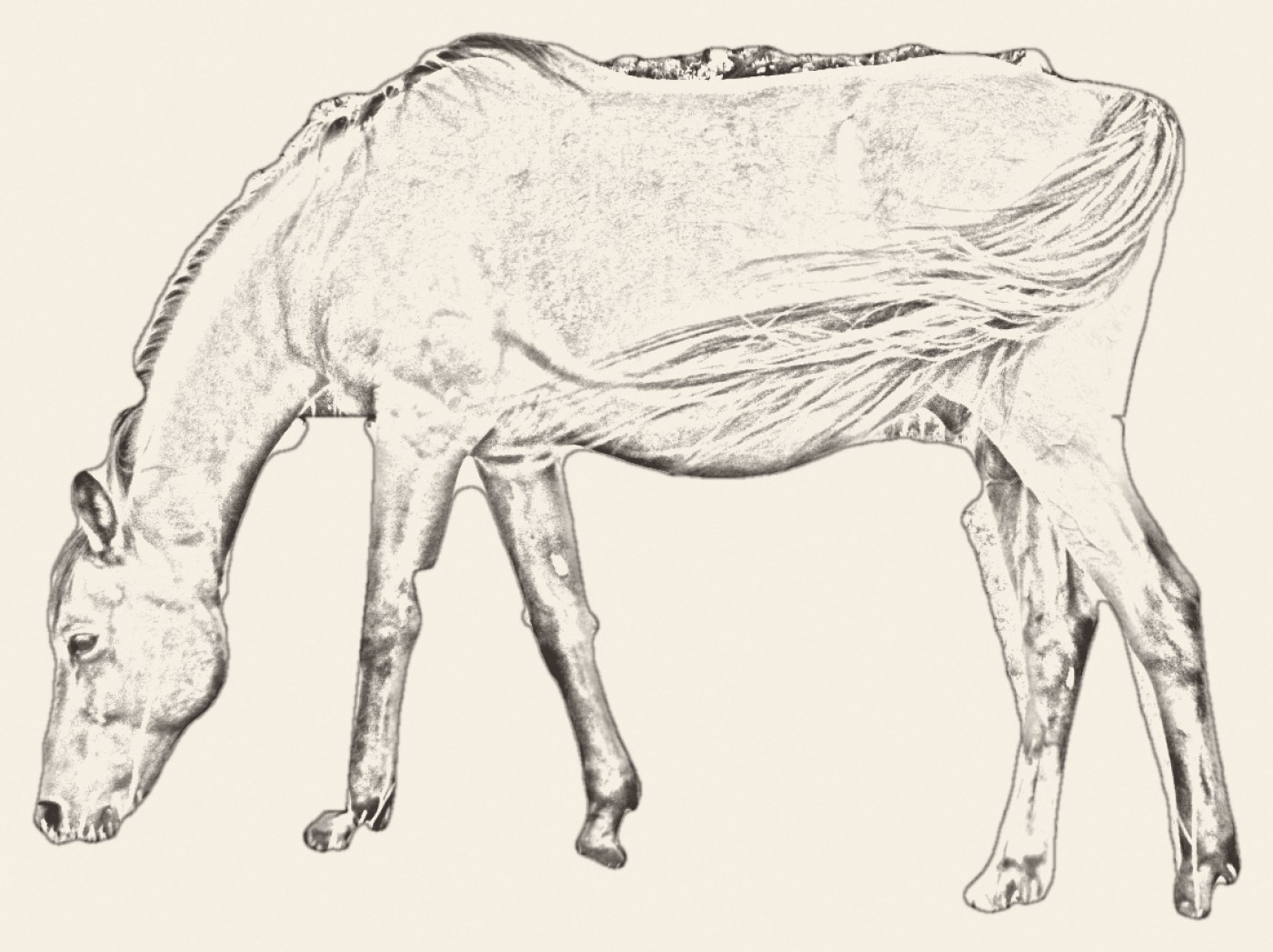
49°
57°
⟷ different shapes, different loading
Laterality shows up on my measuring block.
One horse on our five-week shoeing cycle measured a dorsal wall angle of 49° on the left front and 57° on the right front at its baseline set. That's an 8° difference between the front feet. We measure; we don't guess and we don't diagnose. A number like that tells us where to look — at how the horse stands and grazes, at its movement, at its history — and it gives us an objective baseline to track at every cycle.
Stress shifts the sides. When 14 Quarter Horses were asked to load onto a truck, they preferred to lead with the left foreleg — and showed more anxious behaviour during loading than in the other tasks [39]. When 11 three-year-olds were moved from group housing into individual stables, their sensory laterality shifted left almost immediately and their motor laterality shifted left within a week, alongside higher stress-hormone levels in their dung [40]. In a small study, right-sided horses also behaved more "optimistically" in a judgement test than left-sided ones [41]. (consistent direction across studies; small samples).
A 2022 review drew these threads together: pronounced or increasing left-side preferences may indicate stress or poor welfare, and training should aim for balance, coordination and equal strength on both sides rather than forcing "straightness" on a horse that is naturally asymmetric [29].
Pain can look exactly like laterality. In a clinical study of 128 horses, the saddle consistently slipped to one side in 54% of horses with hindlimb lameness — compared with 4% of horses with forelimb lameness and none of the sound horses [42]. "He's always crooked to the left" can be a sore hind leg.
The science in depthThe myth: "what he learns on one side, he doesn't know on the other"
It's commonly said that horses can't transfer learning from one eye or side to the other because the two halves of the brain "don't talk". That isn't supported. Horses have a corpus callosum and other connections between the hemispheres. When horses learned to recognise objects with one eye, they recognised them with the other [43]. In the umbrella study, horses tested on their right side first showed no side difference afterwards — consistent with what was learned on one side carrying over [23].
(few studies, but consistent).
So why train both sides? Not because information doesn't cross, but because the two halves process the same thing differently — and a new object met first on the left side may simply be judged as more threatening. Working both sides builds balance, coordination and equal strength, and lets the horse meet things through both "lenses".
Your horse's profile
Reading your horse's profile
Most horses have some sidedness — it's normal, and it isn't a fault in your horse. Use this profile in three ways:
- As a baseline. Save it, and check again in a few months. Watch for change, not the score.
- As a pain flag. If one-sidedness appears suddenly, gets stronger, or several answers point the same way alongside saddle slip, resistance on one rein or a change in behaviour — have your horse checked by your vet or physiotherapist before you train it.
- As a training map. Build balance, coordination and equal strength on both sides. Don't force straightness. Present new things on both sides, and give more time on the side where your horse is more reactive.
This check describes what you notice. It doesn't diagnose anything.
- Forcing "straightness" instead of building balance and strength on both sides.
- Labelling one side the "stubborn side".
- Ignoring a sudden change in sidedness.
- Only ever leading, mounting, rugging and grooming from the left.
06Pain: the hidden driver
"Bad temper" is often a sore back. In a study of riding-school horses, 33 of the 43 horses with severe spinal problems reacted aggressively towards people in standard behaviour tests. Among horses with slight or no spinal problems, the proportion was no different from chance [44].
Lameness is common — and usually missed. Of 506 sport horses in normal work, assessed as their owners believed them sound, 46% were lame, had a shortened forward swing of the limbs or a stiff, stilted canter. Saddle slip occurred in 12%, mostly in horses with hindlimb lameness [45].
There is a validated way to look. The Ridden Horse Pain Ethogram is a list of 24 behaviours seen far more often in horses with musculoskeletal pain. When a horse shows 8 or more of them during a ridden assessment, pain is likely [46]. The behaviours fall into groups — the face and eyes (such as ears held back or an intense stare), the mouth and bit (such as repeated mouth opening), the head (such as tilting or tossing), the tail (such as frequent swishing) and the gait (such as toe-dragging or spontaneous changes of gait). In 1,010 starts at British eventing competitions, 9.3% of horses scored 8 or more — and those horses had higher penalty scores [47]. The full list is published by the researchers in their open-access paper.
For the face alone, the Horse Grimace Scale describes specific facial changes associated with pain, first developed in horses after routine castration [48].
8 or more: musculoskeletal pain is likely — call your vet.
Pain changes the nervous system itself. Persistent pain can make the spinal cord and brain more sensitive, so that normal touch starts to hurt and pain outlasts the injury that caused it — a process called central sensitisation [49]. It is well established in people and laboratory animals; in horses the evidence is growing but less complete. in other mammals · in horses.
This is why a horse can stay defensive about girthing, mounting or a particular movement long after a vet has declared the original problem healed. The tissue may have healed. The nervous system's expectation hasn't — yet.
Principle
Pain is a nervous-system input. You can't train it away, and trying teaches the horse that you are part of the problem.
Call your vet or physiotherapist before training if you see any of these
- A sudden change in behaviour, willingness or temperament.
- New or increasing one-sidedness — a rein that has become heavy, a lead that has become difficult, new crookedness.
- A saddle that slips consistently to one side.
- Eight or more Ridden Horse Pain Ethogram behaviours in a ridden session.
- More withdrawn standing or more stereotypies than usual.
- Defensiveness at girthing, mounting, grooming a particular area, or picking up a particular foot.
Then check readiness to carry a rider
Body condition (Henneke 1–9 scale; working horses typically 5–6) plus topline and posture. If the body isn't ready to carry a rider, the work is groundwork that builds the body first.
- "Riding through it."
- "He's always been like that" — long-standing behaviour can still be pain.
- Assuming a standing vet check rules out pain that only shows under saddle.
- Treating defensiveness after an injury as a training problem without addressing the sensitised nervous system patiently.
07Regulation is trainable: how HFA builds it
At Horse Flow Academy everything we teach sits on one principle. Your goals direct the path. Your horse's foundation decides what's achievable. Tension is the gap between the two. And the foundation has three parts: behavioural bandwidth (how many situations the horse can handle while staying responsive), regulation depth (how far it can be stretched and how quickly it comes back) and biomechanical integrity (a body, hooves and posture able to do the job, free of pain).
All three rest on the nervous system (Plate 13). We look at them in three dimensions: what you can observe (behaviour and posture — 2D), what is structural (body, hoof, muscle — 3D) and what is neurobiological and happening over time (state, learning, recovery — 4D).
Nine nervous-system rules for training
| # | Rule | Why | Evidence |
|---|---|---|---|
| 1 | Read the state before you ask. | Learning happens in the calm, attentive zone. | |
| 2 | Ask half the question. | Small, clear steps keep the horse in the learning zone and let you change the question. | |
| 3 | Pulse, don't push. | Rhythmic ask-and-concede gives the horse something to find instead of something to brace against. | |
| 4 | Release at the first flicker. | The release connects to the behaviour only within about 0.3–2 seconds. | window measured in other mammals |
| 5 | Protect the long release. | Rest after learning lets the brain replay and consolidate — in people, replay during short rests has been measured at about twenty times the original pace [50]. | |
| 6 | Low energy first, energy later. | Lightness before responsiveness; precision before pace. Adding energy before the pathway holds is always a mess. | |
| 7 | Build both sides for balance — don't force straightness. | Forced straightening may add stress; balance, coordination and equal strength reduce it [29]. | |
| 8 | Rule out pain first. | Pain is a nervous-system input you can't train away [44–47]. | |
| 9 | Regulate yourself first. | Your nervous system is one of the signals your horse monitors [2]. |
scroll →
What regulation looks like. My horse Aragon loads into a horsebox at liberty — no halter, no rope, no tools. People watch it and see a trick. What it really shows is a nervous system that has learned the horsebox predicts nothing bad, and a horse in the calm, attentive zone doing an ordinary job. It's the same task every horse owner has. It's a different state.
Scaling progression
- Standstill regulation — the horse can stand, be handled and be asked small things while staying soft. (Compass block 1: standstill.)
- Slow-motion locomotion and half-steps — one leg, one joint, one question at a time. (Compass block 2: direct locomotion.)
- Changing the question — shoulder, then hindquarter, then turns and transitions. (Compass block 3: Turn & Go.)
- Adding energy — more pace within each gait while the horse stays calm and precise.
- The uncontrolled environment — the same skills at a show, on an outride, in a new place.
At the clinic
08Your next step
Garden Route Two-Day Clinic
21–22 November 2026 · Swartvlei Guest Farm
Bring your horse and work through regulation, the slow-motion pole protocol and liberty for everyday tasks — or join as an auditor. Theory and practical sessions on both days.
Book your place →Places for participants with horses are limited. You can also book on WhatsApp: 071 611 0734
The Horse Flow app
Assess your horse's foundation with the HFA Compass, which scores it across standstill, locomotion and Turn & Go — and track progress in your training diary, session by session. Reassess after every clinic and see what has changed.
Get the app →Horse Flow Academy doesn't change what you do with your horse. It changes the state your horse does it in.
✓The evidence, claim by claim
Every claim above, with what the research actually shows and how much weight it can bear. Tap a filter, or tap the Grade heading to sort.
| Claim | What the research shows | Study type | |
|---|---|---|---|
| The nervous system has central, peripheral, autonomic and enteric parts | Standard anatomy and physiology across mammals | Textbook | |
| Threat signals take a fast route before a detailed one | Shown in rodents, primates and humans; same structures exist in horses; timing not measured in horses [1] | Experimental neuroscience (non-horse) | |
| Adrenaline acts in seconds; cortisol peaks over ~15–30 min and clears more slowly | General mammalian stress physiology | Textbook | |
| A handler's nervousness raises the horse's heart rate | Horse and human heart rates both rose when handlers expected a scare that never came [2] | Experimental, 27 horses | |
| Blink rate falls and eyelid twitches rise under mild stress | 33 horses across four conditions [3] | Experimental | |
| Licking and chewing marks the shift from tense to relaxed | Feral horse observations [4] | Observational, conference data | |
| HRV reflects autonomic balance but horse methods vary widely | Reviews [5,6] | Narrative reviews | |
| Gut bacteria are associated with training conditions and behaviour | 185 sport horses over 8 months [7] | Observational | |
| Stress interacts with temperament to change learning; contexts can "remember" stress | [8] | Experimental | |
| Under background stress, learning drops less with pressure-release than with food reward | 60 horses, four groups [9] | Experimental | |
| Fear memories return after extinction; fearful horses resist extinction | [10,11] | Experimental (mammals; horses) | mechanism horses |
| Withdrawn posture is not calm: less responsive at home, more reactive in challenge, lower cortisol, loss of pleasure | 59 horses; follow-up study [12,13] | Observational + experimental | |
| Upper-line posture reflects welfare state and back health | 85 horses, geometric morphometrics [14–16] | Observational | |
| The hoof contains touch, pressure, vibration and pain receptors | Histology [17,18] | Anatomical | |
| Poles increase joint flexion in the swing phase | 8 horses, kinematics [19] | Experimental | |
| The nervous system habituates to repetitive tactile stimulation | Forelimb effect faded after ~6 trials [20,21] | Experimental, 8 horses | |
| Slow-motion half-step pole work down-regulates horses | HFA practice, including one CVCM case (programme not finished) | Field observation | |
| Horses react more to threats seen with the left eye | [23–27] | Experimental, several small studies | |
| Domestic horses show left forelimb grazing bias that grows with age; feral horses don't | Thoroughbreds; review [28,29] | Observational | |
| Canter/gallop lead preferences | Strong right bias in one study, none at population level in 2,095 race starts [30,31] | Observational | mixed |
| Rider-perceived sidedness doesn't always match measured asymmetry | 123 sport horses; survey of 2,304 riders [34,35] | Observational / survey | |
| Chewing-side preference exists and relates to sidedness | Anatomical asymmetry; one field study [36,37] | Anatomical / cross-sectional | |
| Grazing-leg preference in foals leads to uneven front feet | 24 foals over one year [38] | Longitudinal observational | |
| Stress shifts laterality to the left | [39,40,41] | Experimental, small samples | |
| Saddle slip to one side signals hindlimb lameness | 128 horses, before and after nerve blocks [42] | Clinical study | |
| Learning transfers between eyes | [43,23] | Experimental | |
| Chronic back problems are linked with aggression to humans | 33 of 43 severely affected horses [44] | Observational | |
| Nearly half of "sound" sport horses are lame or stiff in canter | 506 horses [45] | Cross-sectional | |
| 8+ of 24 ridden behaviours indicates likely pain | Validated ethogram; 1,010 competition starts [46,47] | Validation + field application | |
| Persistent pain sensitises the nervous system | [49] | Human and animal research | mammals horses |
| Brief rests after practice allow fast neural replay | Human study [50] | Experimental (human) |
scroll →
§References
- LeDoux, J.E. (2000). Emotion circuits in the brain. Annual Review of Neuroscience, 23, 155–184.↩1↩2
- Keeling, L.J., Jonare, L. & Lanneborn, L. (2009). Investigating horse–human interactions: the effect of a nervous human. The Veterinary Journal, 181(1), 70–71.↩1↩2↩3
- Merkies, K., Ready, C., Farkas, L. & Hodder, A. (2019). Eye blink rates and eyelid twitches as a non-invasive measure of stress in the domestic horse. Animals, 9(8), 562.↩1↩2
- Lie, M. & Newberry, R.C. (2018). Conference presentation on non-nutritive licking and chewing in feral horses (observational), 14th International Society for Equitation Science Conference, Rome. Conference data only.↩1↩2
- von Borell, E., Langbein, J., Després, G. et al. (2007). Heart rate variability as a measure of autonomic regulation of cardiac activity for assessing stress and welfare in farm animals — a review. Physiology & Behavior, 92(3), 293–316.↩1↩2
- Stucke, D., Große Ruse, M. & Lebelt, D. (2015). Measuring heart rate variability in horses to investigate the autonomic nervous system activity — pros and cons of different methods. Applied Animal Behaviour Science, 166, 1–10.↩1↩2
- Mach, N., Ruet, A., Clark, A. et al. (2020). Priming for welfare: gut microbiota is associated with equitation conditions and behavior in horse athletes. Scientific Reports, 10, 8311.↩1↩2
- Valenchon, M., Lévy, F., Prunier, A., Moussu, C., Calandreau, L. & Lansade, L. (2013). Stress modulates instrumental learning performances in horses (Equus caballus) in interaction with temperament. PLoS ONE, 8(4), e62324.↩1↩2↩3
- Valenchon, M., Lévy, F., Moussu, C. & Lansade, L. (2017). Stress affects instrumental learning based on positive or negative reinforcement in interaction with personality in domestic horses. PLoS ONE, 12(5), e0170783.↩1↩2↩3
- Valenchon, M., Lévy, F., Górecka-Bruzda, A., Calandreau, L. & Lansade, L. (2013). Characterization of long-term memory, resistance to extinction, and influence of temperament during two instrumental tasks in horses. Animal Cognition, 16(6), 1001–1006.↩1↩2↩3
- Bouton, M.E. (2004). Context and behavioral processes in extinction. Learning & Memory, 11(5), 485–494.↩1↩2
- Fureix, C., Jego, P., Henry, S., Lansade, L. & Hausberger, M. (2012). Towards an ethological animal model of depression? A study on horses. PLoS ONE, 7(6), e39280.↩1↩2
- Fureix, C., Beaulieu, C., Argaud, S., Rochais, C., Quinton, M., Henry, S., Hausberger, M. & Mason, G. (2015). Investigating anhedonia in a non-conventional species: do some riding horses Equus caballus display symptoms of depression? Applied Animal Behaviour Science, 162, 26–36.↩1↩2
- Sénèque, E., Lesimple, C., Morisset, S. & Hausberger, M. (2019). Could posture reflect welfare state? A study using geometric morphometrics in riding school horses. PLoS ONE, 14(2), e0211852.↩1↩2
- Sénèque, E., Morisset, S., Lesimple, C. & Hausberger, M. (2018). Testing optimal methods to compare horse postures using geometric morphometrics. PLoS ONE, 13(10), e0204208.↩1↩2
- Lesimple, C., Fureix, C., De Margerie, E., Sénèque, E., Menguy, H. & Hausberger, M. (2012). Towards a postural indicator of back pain in horses (Equus caballus). PLoS ONE, 7(9), e44604.↩1↩2
- Bowker, R.M., Brewer, A.M., Vex, K.B., Guida, L.A., Linder, K.E., Sonea, I.M. & Stinson, A.W. (1993). Sensory receptors in the equine foot. American Journal of Veterinary Research, 54(11), 1840–1844.↩1↩2
- Bowker, R.M., Lancaster, L.S. & Isbell, D.A. (2017). Morphological evaluation of Merkel cells and small lamellated sensory receptors in the equine foot. American Journal of Veterinary Research, 78(6), 659–667.↩1↩2
- Brown, S., Stubbs, N.C., Kaiser, L.J., Lavagnino, M. & Clayton, H.M. (2015). Swing phase kinematics of horses trotting over poles. Equine Veterinary Journal, 47(1), 107–112.↩1↩2↩3
- White, A.D., Kaiser, L.J., Nauwelaerts, S., Lavagnino, M., Stubbs, N.C. & Clayton, H.M. (2008). Short-term habituation of equine limb kinematics to tactile stimulation of the coronet. Veterinary and Comparative Orthopaedics and Traumatology, 21(3), 211–214.↩1↩2↩3
- Clayton, H.M., Lavagnino, M., Kaiser, L.J. & Stubbs, N.C. (2011). Evaluation of biomechanical effects of four stimulation devices placed on the hind feet of trotting horses. American Journal of Veterinary Research, 72(11), 1489–1495.↩1↩2↩3
- Paulekas, R. & Haussler, K.K. (2009). Principles and practice of therapeutic exercise for horses. Journal of Equine Veterinary Science, 29(12), 870–893.↩1↩2
- Austin, N.P. & Rogers, L.J. (2007). Asymmetry of flight and escape turning responses in horses. Laterality, 12(5), 464–474.↩1↩2↩3↩4
- Larose, C., Richard-Yris, M.-A., Hausberger, M. & Rogers, L.J. (2006). Laterality of horses associated with emotionality in novel situations. Laterality, 11(4), 355–367.↩1↩2
- De Boyer des Roches, A., Richard-Yris, M.-A., Henry, S., Ezzaouïa, M. & Hausberger, M. (2008). Laterality and emotions: visual laterality in the domestic horse (Equus caballus) differs with objects' emotional value. Physiology & Behavior, 94(3), 487–490.↩1↩2
- Farmer, K., Krueger, K. & Byrne, R.W. (2010). Visual laterality in the domestic horse (Equus caballus) interacting with humans. Animal Cognition, 13(2), 229–238.↩1↩2
- Sankey, C., Henry, S., Clouard, C., Richard-Yris, M.-A. & Hausberger, M. (2011). Asymmetry of behavioral responses to a human approach in young naive vs. trained horses. Physiology & Behavior, 104(3), 464–468.↩1↩2
- McGreevy, P.D. & Rogers, L.J. (2005). Motor and sensory laterality in thoroughbred horses. Applied Animal Behaviour Science, 92(4), 337–352.↩1↩2
- Krueger, K., Schwarz, S., Marr, I. & Farmer, K. (2022). Laterality in horse training: psychological and physical balance and coordination and strength rather than straightness. Animals, 12(8), 1042.↩1↩2↩3↩4
- Williams, D.E. & Norris, B.J. (2007). Laterality in stride pattern preferences in racehorses. Animal Behaviour, 74(4), 941–950.↩1↩2
- Cully, P., Nielsen, B., Lancaster, B., Martin, J. & McGreevy, P. (2018). The laterality of the gallop gait in Thoroughbred racehorses. PLoS ONE, 13(6), e0198545.↩1↩2↩3
- Murphy, J., Sutherland, A. & Arkins, S. (2005). Idiosyncratic motor laterality in the horse. Applied Animal Behaviour Science, 91(3–4), 297–310.↩
- Wells, A.E.D. & Blache, D. (2008). Horses do not exhibit motor bias when their balance is challenged. Animal, 2(11), 1645–1650.↩
- Zetterberg, E., Persson-Sjodin, E., Lundblad, J., Hernlund, E. & Rhodin, M. (2024). Prevalence of movement asymmetries in high-performing riding horses perceived as free from lameness and riders' perception of horse sidedness. PLoS ONE, 19(7), e0308061.↩1↩2
- MacKechnie-Guire, R., Clayton, H., Byström, A., Marlin, D., Haussler, K., Latif, S., Blum, N., le Jeune, S.S., Wanless, M. & Egenvall, A. (2025). International survey exploring rider-perceived sidedness of the horse. Animals, 15(13), 1956.↩1↩2
- Parés-Casanova, P.M. & Morros, C. (2014). Molar asymmetry shows a chewing-side preference in horses. Journal of Zoological and Bioscience Research.↩1↩2
- Mebarki, M., Lounas, A., Abdelli, A., Berezzel, F., Behar, C., Laghouati, A., Yahimi, A., Khaled, H. et al. (2026). Morphological and behavioural predictors of motor laterality in domestic horses: a cross-sectional field study. Behavioural Processes, 243, 105444.↩1↩2
- van Heel, M.C.V., Kroekenstoel, A.M., van Dierendonck, M.C., van Weeren, P.R. & Back, W. (2006). Uneven feet in a foal may develop as a consequence of lateral grazing behaviour induced by conformational traits. Equine Veterinary Journal, 38(7), 646–651.↩1↩2↩3
- Siniscalchi, M., Padalino, B., Lusito, R. & Quaranta, A. (2014). Is the left forelimb preference indicative of a stressful situation in horses? Behavioural Processes, 107, 61–67.↩1↩2
- Marr, I., Preisler, V., Farmer, K., Stefanski, V. & Krueger, K. (2020). Non-invasive stress evaluation in domestic horses (Equus caballus): impact of housing conditions on sensory laterality and immunoglobulin A. Royal Society Open Science, 7(2), 191994.↩1↩2
- Marr, I., Farmer, K. & Krüger, K. (2018). Evidence for right-sided horses being more optimistic than left-sided horses. Animals, 8(12), 219.↩1↩2
- Greve, L. & Dyson, S.J. (2013). An investigation of the relationship between hindlimb lameness and saddle slip. Equine Veterinary Journal, 45(5), 570–577.↩1↩2
- Hanggi, E.B. (1999). Interocular transfer of learning in horses (Equus caballus). Journal of Equine Veterinary Science, 19(8), 518–524.↩1↩2
- Fureix, C., Menguy, H. & Hausberger, M. (2010). Partners with bad temper: reject or cure? A study of chronic pain and aggression in horses. PLoS ONE, 5(8), e12434.↩1↩2↩3
- Greve, L. & Dyson, S.J. (2014). The interrelationship of lameness, saddle slip and back shape in the general sports horse population. Equine Veterinary Journal, 46(6), 687–694.↩1↩2↩3
- Dyson, S., Berger, J., Ellis, A.D. & Mullard, J. (2018). Development of an ethogram for a pain scoring system in ridden horses and its application to determine the presence of musculoskeletal pain. Journal of Veterinary Behavior, 23, 47–57.↩1↩2↩3↩4
- Dyson, S. & Pollard, D. (2022). Application of the Ridden Horse Pain Ethogram to horses competing in British Eventing 90, 100 and Novice one-day events and comparison with performance. Animals, 12(5), 590.↩1↩2↩3↩4
- Dalla Costa, E., Minero, M., Lebelt, D., Stucke, D., Canali, E. & Leach, M.C. (2014). Development of the Horse Grimace Scale (HGS) as a pain assessment tool in horses undergoing routine castration. PLoS ONE, 9(3), e92281.↩
- Woolf, C.J. (2011). Central sensitization: implications for the diagnosis and treatment of pain. Pain, 152(3 Suppl), S2–S15.↩1↩2
- Buch, E.R., Claudino, L., Quentin, R., Bönstrup, M. & Cohen, L.G. (2021). Consolidation of human skill linked to waking hippocampo-neocortical replay. Cell Reports, 35(10), 109193.↩1↩2