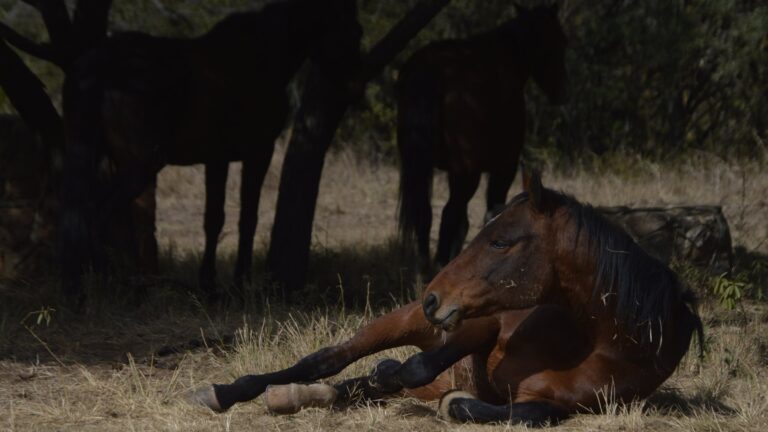
Pressure & release · The journal
Pressure doesn't teach.
Release does.
The context window, pulsing pressure, and the difference between a micro-release and a macro-release. Or: what people are actually pointing at when they say feel.
Almost every argument in horsemanship is an argument about pressure. How much. How firm. Whether to use it at all.
It is the wrong argument.
How to read this. Thirteen short sections, plain language first and the evidence right behind it. Every claim carries a tag telling you how strong the science actually is — including the ones where the honest answer is we don't know yet. Four of the sections have something you can play with; those are the fastest way in if you are short on time.
Contents — 13 sections
- 01The argument is in the wrong place
- 02Three corrections before we start
- 03The mechanism: relief is a reward
- 04The context window
- 05Pulsing, not something to lean on
- 06Micro-release and macro-release
- 07What happens in the pause
- 08What the timing studies show
- 09Reading the threshold
- 10Why it holds in the real world
- 11The four release errors
- 12What we still don't know
- 13So what is feel?
1The argument is in the wrong place
In a pressure-release system, pressure is not what teaches. Pressure is the motivator — the reason the horse trials a behaviour in the first place. What teaches is the release. And because the release is the reinforcer, the entire system is decided by when the pressure stops, not by how hard it was applied.
This is not a philosophical position. It is the most consistently replicated finding in equitation science, and the one most consistently misapplied in the field.
What follows is what the evidence says about that moment — and then the part the evidence doesn't yet reach, which is where the actual craft lives.
2Three corrections before we start
"Negative" is arithmetic, not a moral judgement
Negative reinforcement means subtraction — something is taken away. It does not mean harsh, or unkind. Positive reinforcement means addition, not good.
McLean and Christensen, in the standard review of learning theory in horse training, argue formally that the terms should be replaced with addition and subtraction reinforcement — precisely because trainers read the moral meaning instead of the mathematical one, and that misreading stops people understanding the process they are already using every single day.
Evidence: strong · terminological consensus
The four quadrants are a filing system, not a description of the horse
Consider leading. Pressure on the poll, released when the horse steps forward. Forward movement is reinforced. But in that same instant, standing still is being punished. Same stimulus, two contingencies, one moment. And the horse's nervous system does not sort them by what you intended.
McLean and Christensen quote Dawkins on exactly this: the tyranny of the discontinuous mind. The boxes are ours. The horse does not live in them.
Evidence: strong · theoretical, multiple independent authors
Every training error is a release error first
If the release is the reinforcer, then every failure in the system is a failure of release before it is anything else.
Which means the diagnostic question is never was I too strong? It is:
What was the horse doing at the exact moment the pressure stopped?
3The mechanism: relief is a reward
Here is the part that changes how you see the release.
When an expected unpleasant event does not arrive, the brain does not register nothing. It registers a better-than-expected outcome — and fires a reward-like prediction error signal, carried by dopamine neurons in the ventral tegmental area, recruiting the nucleus accumbens, amygdala and hippocampus to lay down a safety memory.
Relief, measured neurologically, meets the formal definition of a reward. Not as a metaphor. Structurally.
Two consequences follow, and they are the whole game:
- The signal is strongest when the omission is unexpected, and fades as it becomes fully predicted. A release the horse has completely anticipated teaches less than one that resolves real uncertainty.
- No release means no event, which means no learning signal at all. Failure to release does not produce a weaker version of learning. It produces sustained discomfort and habituation, with no teaching signal generated at any point.
This is the mechanism sitting underneath everything trainers describe as feel, timing, or softness. The release is not the absence of an event.
The release is the event.
Evidence: mechanistic · established in humans and rodents, not directly measured in horses
4The context window: a release without context teaches nothing
Now the first nuance, and it is the one that quietly ruins most people's training.
A release only teaches if the horse can connect it to something. And the window in which that connection can form is far narrower than almost anyone assumes.
If you ask a question, hold pressure for ten minutes, and then release — what has the horse learned? Released from what? For doing what? Which of the four hundred things it did in those ten minutes was the answer? The release lands in a vacuum. It relieves the horse, and it teaches nothing, because there is no longer a specific behaviour close enough in time to be attached to it.
What the number actually is
At cellular level this is called an eligibility trace — a temporary chemical "tag" left on the synapses that were just active, marking them as available to be strengthened if a reward signal arrives soon enough. If the reward signal arrives inside the window, the connection strengthens. If it arrives outside, nothing happens at all.
Yagishita and colleagues measured that window directly in 2014. Dopamine enlarged the tagged synapse only when it arrived within roughly 0.3 to 2 seconds of the input. Outside that window — too early or too late — the change simply did not occur. Not a reduced version of it. None.
So the working figure of "about three seconds" that gets passed around clinics is generous. The honest number is closer to one to two seconds. Which makes the point more strongly, not less.
Interactive · 01
Drag the delay. Watch the lesson disappear.
Inside the window.
The synapses that produced the response are still tagged. The release lands on the right behaviour.
The shaded band is the 0.3–2 second window Yagishita and colleagues measured. The curve is a schematic of how the effect falls away outside it, not a second set of measurements.
That window was measured in mouse striatum, not in horses. Nobody has measured an equine eligibility trace. But the mechanism is conserved across mammals, and it lines up precisely with the behavioural finding in horses that releasing at the first attempt — not the finished movement — produces dramatically lighter responses. Treat it as a well-supported explanation, not as an equine measurement.
The practical consequence is blunt. You are not training the horse for the duration of the pressure. You are training whatever it did in the last second or two before the pressure stopped. Everything else in that ten minutes is noise — and worse, it is noise the horse is enduring without learning from.
- Decide the answer before you ask. If you cannot say out loud what you will release for, you will not recognise it in time.
- Ask for one thing. A question with two acceptable answers has no releasable moment.
- If ten seconds pass with no release, stop. You are no longer teaching. Lower the bar until there is something to release for.
5Pulsing pressure, not something to lean against
Which brings us to the second nuance: how the pressure is applied between releases.
Steady, constant pressure gives the horse something to brace against. Physically it invites a lean — the horse meets force with force. Neurologically it does something worse: a continuous stimulus of unchanging intensity is the textbook recipe for habituation. The horse stops registering it. This is exactly how a "hard mouth" and "dead sides" are manufactured, and neither has anything to do with temperament.
The alternative is pulsing pressure. On, off, on, off — a rhythmic ask rather than a sustained hold. Some people call it rhythmic pressure. At Horse Flow we call it pulsing, and the feel we describe to students is a half-halt: a quick, clear ask-and-concede rather than a push.
Two things happen when you pulse. There is nothing to lean on, so the brace has no target. And every pulse is a fresh onset, which keeps the signal salient instead of letting it fade into background.
Interactive · 02
What your hands look like from the horse's side
Pulsing pressure.
Nothing to lean against. Each pulse is a fresh onset, so the signal stays salient instead of fading into background.
6Micro-release and macro-release
Here is the structure that ties the first two nuances together, and it is the part I teach most often because it is the part that changes horses fastest.
There are two different releases doing two different jobs.
The micro-release
"Thanks for trying — keep going"
The small concessions between the pulses. When I feel the horse begin to find the idea — not arrive at it, just begin — I release for a second or two. Then I continue asking. Another flicker of the right idea, another small release. A micro-release does not end the question. It marks progress inside it. It says: that direction. More of that.
The macro-release
"You got it"
When the horse has genuinely caught the answer — not approximated it, caught it — the pressure comes off completely and stays off. Ten seconds. Thirty. Sometimes several minutes. How long depends on the horse: how it is processing, how distracted it is, how novel the lesson was. The macro-release ends the question — and as the next section shows, it is where most of the learning actually happens.
The same structure in the regulation domain
Everything above describes movement — a yield, a step, a transition. The same structure applies to state, and this is where it matters most.
When a tense horse begins to down-regulate, the release should come at the first flicker of relaxation — not at the finished lick-and-chew. A softening eye. A dropped breath. A half-degree of poll release. Release there, and the horse follows through on its own: the lick-and-chew arrives, then the yawn, then progressively deeper release, all of it self-generated.
Wait for the full expression before releasing and you have done two things wrong. You have missed the window — the flicker was the behaviour, and it was over a second ago. And you have taught the horse that softening is not enough, which is the fastest way to stop it offering the softening at all.
Release on the try, and the horse completes it for you. Wait for the completion, and you lose the try.
Lightness first. Responsiveness after.
There is a distinction buried here that almost nobody separates, and separating it is the whole answer to the latency problem.
Lightness is how much pressure it takes to get an answer. Responsiveness is how fast the answer arrives. They are two different properties. They are measured separately. And they are built at different times.
In the acquisition phase I train slowly and deliberately, at low energy, and I reward lightness and softness — the horse becoming willing to answer. At this stage the response will be slow, and that is not a fault to be corrected. It is the cost of building the pathway cleanly. Trying to fix latency here, by adding energy before the horse knows the answer, produces exactly what you would expect: a fast, tense, inaccurate response, and a horse that has now practised confusion at speed.
Once the pathway is established — the horse reliably knows the question and offers the answer softly — then the energy goes up. Impulsion is added behind a movement the horse already owns, and the latency closes on its own. You are no longer teaching the response. You are only teaching how promptly to produce it.
Slow to build the pathway. Fast only once it holds.
This is not just field preference. The equitation science shaping scale places basic attempt first and obedience — immediate response to a light aid — second, in that order, for the same reason. And the arousal research says the optimal level of energy moves with task difficulty: a novel, difficult task needs low arousal to be learned at all, while a consolidated, easy one tolerates far more. Raising the energy before the pathway exists is not impatience. It is asking the horse to perform a difficult task at an arousal level suited to an easy one.
Why this resolves a real problem in the literature. The 2025 rein-tension study found that releasing early produced lighter horses but slower responses. Two readings fit that result equally well, and the data cannot separate them: the horse had become less motivated to complete the transition promptly, or the horse had become unsure what was being asked — a transition, or merely a slower trot.
The two nuances in this section answer one reading each.
Uncertainty is answered by the micro-release. An early release only creates confusion if the horse reads it as the end of the question. A micro-release inside continuing pulsing pressure is unambiguous — the question is visibly still open, and only the macro-release signals completion.
Motivation is answered by sequencing. The latency is real, it is accepted deliberately during acquisition, and it is closed afterwards by adding energy once the pathway will carry it.
Read that way, the finding is not an argument against early release. It is a description of what early release costs, and of the two things you have to do about it.
- Name the release before you give it. Micro or macro. If you cannot tell which one you just gave, neither can the horse.
- Never end a session on a micro-release. Finish on a macro, or the horse leaves with the question still open.
- Accept the slow answer while it is still new. Speed is the last thing you add, not the first.
7What happens in the pause
Most people treat the pause after a good response as generosity. A reward. Being kind to the horse.
It is not generosity. It is the second half of the lesson.
In 2006, Foster and Wilson recorded rat hippocampus during quiet, awake moments immediately after the animal had run a track. The neurons that had fired during the run fired again — compressed, at high speed, and in reverse order, starting from where the animal now stood and running backwards through what it had just done. The authors noted it looked exactly like the evaluation step in a reinforcement learning model. Later work confirmed that this reverse replay is specifically tied to reward.
In 2021, Buch and colleagues at the NIH found the same thing in people. Participants practised a five-key sequence in ten-second bursts, each followed by a ten-second rest. During those rests, the brain replayed the sequence roughly twenty times faster than it had been physically performed — on the order of two dozen replays per rest period. Replay was densest in the earliest trials, when the skill was newest. And the volunteers who replayed more improved more: the amount of replay predicted the size of the gain.
The finding that matters most: the gains showed up in the rests, not in the practice. Most of the early learning was happening while the participants were doing nothing at all.
The horse standing still after a good release is not resting. It is running the repetition again, at speed, backwards, a couple of dozen more times.
That is what the macro-release buys. Not a reward — consolidation time. If you release for one second and immediately ask again, you have interrupted the most productive part of the lesson to deliver a less productive one.
And it explains something every good trainer already knows by feel: that the horse which stands quietly and softens, chews, blinks, lowers its head after a release has genuinely got something. It is not being polite. It is consolidating.
Evidence: strong in rodents and humans · not measured in horses
Nobody has recorded replay in a horse. The rat work is direct neural recording; the human work is MEG imaging of a finger-tapping task. Applying it to a horse learning a lateral yield is an extrapolation across both species and task type. It is a well-founded reason to protect the pause — it is not proof that a horse's pause works identically. Anyone telling you otherwise has stopped reading the papers and started selling something.
8What the timing studies actually show
One second. Eight repetitions. Half the pressure.
Eisersiö and colleagues measured it. Twenty Warmbloods, in hand, asked to step back from a rein signal. Release the rein within about one second of the horse lifting its first front hoof, and the tension needed to get the same answer halved — across only eight repetitions, inside a single session. The paper's own title says it plainly: a rein tension signal can be reduced by half in a single training session.
Egenvall's group had already established the direction: release at the horse's first attempt, not at the completed transition, and you get lower rein tension and fewer conflict behaviours.
Release at the onset of the response. Not at its completion. Not at its perfection.
Evidence: moderate to strong · small samples, direct instrumentation
Late release is not neutral — it is punishment
By definition, punishment makes a response less likely. A delayed release makes the correct response less likely. McGreevy and McLean describe a continuum running from poorly timed negative reinforcement straight into punishment — with no bright line between them, and no requirement that you intended any of it.
The horse's window is narrower than a dog's
You can be later reinforcing a dog than a horse. The horse's prefrontal cortex is considerably less extensive than ours, and prospective memory in horses remains a substantial research gap. Assuming a horse can connect a consequence to something it did several seconds ago is not generosity toward the animal — it is the assumption underwriting delayed rewards and retrospective punishment, and it has no evidential support.
Interactive · 03
You are not slow. Prove it to yourself.
Pressure goes on. Somewhere in the next few seconds the horse tries. Release the instant it does — click the panel, or press the Release button. Five rounds.
Press Start when you're ready.
Five rounds, then we'll do the arithmetic.
Human reaction time to an obvious signal runs somewhere around a quarter of a second. The window you are aiming at is one to two seconds. That gap is the point of this exercise.
The cue here is unmissable, which is exactly what a real try is not. This measures your reaction, not your perception — and that is the finding. Nobody is late because their hands are slow.
9Reading the threshold: the horse is already telling you
Eisersiö's group instrumented twenty horses with a rein tension meter and measured the tension at the start and the end of specific behaviours — unridden, handler at the withers, asking for a step back. Two categories emerged, and they mean opposite things.
Mean rein tension, sum of both reins, at the onset and the end of each behaviour. Bar length shows the size of the change, and the side of the line shows its direction.
Mouth-opening, bit-biting and head-raising are the horse reducing pressure on its own tissues — a crude, undesirable form of yielding. Head forward and head down are the horse increasing pressure, trying to break free rather than yield.
To an untrained eye these look like the same category of resistance. They are not. One is a horse working the problem. The other is a horse trying to end it by force. Release on the second and you have taught the horse to pull.
The number that actually calibrates your hands
This is worth getting exactly right, because it is usually quoted wrong.
- The signal itself was tiny — a median of around 4 newtons across both reins. That is the weight of a small apple.
- The horse only began producing oral behaviour and head movement once tension climbed to about 10 N across both reins — roughly 5 N in each hand. That is the threshold at which a horse starts telling you it has had enough.
- The authors suggest that around 10 N in each rein may be about the limit of what a horse is comfortable carrying in its mouth at all.
Which gives you a usable scale. Under five newtons a side is conversation. Ten a side is the ceiling. Twenty-seven newtons — the point at which these horses started shoving their noses forward — is an argument you have already lost.
And here is the detail that closes the loop on this whole article. Those behaviours were fast. The median duration of a head movement or a gape was under one second. So the horse's own commentary — the flicker that tells you whether it is yielding or escaping, and whether you are near the ceiling — arrives and is gone inside exactly the same window you have to release in. You are not reading the horse and then deciding. The reading and the release are the same event.
- Watch the mouth, not the feet. A gape or a bit-chew is the horse telling you the pressure is above its comfort line — before the legs say anything.
- Never release on head-forward or head-down-and-through. That is the one release that teaches pulling.
- If you need more than a kilogram a side, the answer is not more. It is a smaller question.
10Why correct pressure-release holds up in the real world
Under unrelated stress, it degrades less
Valenchon and colleagues ran sixty horses across four groups of fifteen. With no external stressors, learning did not differ between negative and positive reinforcement. With stressors unrelated to the task, learning was impaired in both — but the deficit was smaller under negative reinforcement. The task-related pressure appeared to counterbalance the extrinsic stressor by focusing attention.
The claim is smaller impairment under stress. It is not better learning in general. That distinction gets lost constantly and it matters.
The finding that should be better known
Freymond's group compared the two approaches on twelve mares, six per group, then tested the horses' outlook afterwards. During training, the behavioural measures pointed the way you would expect — the negatively reinforced horses looked less comfortable. Afterwards, in a judgment bias test, those same horses were more optimistic: quicker to approach an ambiguous location.
The same inversion appears elsewhere. Dogs have been found more pessimistic following a rewarding event. Sheep showed a positive shift in outlook after release from restraint.
The unifying explanation is the one from section three: relief is rewarding. Which means in-session appearance and post-session state are separate measurements, and they can point in opposite directions. Pleasant-looking sessions do not guarantee a well-adjusted horse. Businesslike sessions do not indicate a damaged one.
Evidence: suggestive · twelve mares, six per group — a small study carrying a large idea
Controllable arousal helps. Uncontrollable arousal does not.
Henshall's group assigned forty-one horses to ridden exercise, uncontrollable stress, or doing nothing, then tested learning. Exercised horses reached criterion in the fewest trials. Uncontrollably stressed horses did no better than the horses that had done nothing at all.
Which points at the two variables that actually govern whether pressure is tolerable — not magnitude, but predictability (a light signal that reliably forecasts the pressure) and controllability (the horse can act to switch it off). A moderate but unpredictable, inescapable pressure is worse for a horse than a firmer one it can see coming and turn off.
The horse is not asking you to be soft. It is asking you to be predictable, and to let it switch you off.
11The four ways a release goes wrong
Everything above collapses into four field-diagnosable errors.
Late release
The horse offers the response and the pressure persists. Functionally this is punishment of the right answer. Produces conflict behaviour first, then habituation.
Ambiguous early release
Pressure ends before the answer is offered, and ends the question with it. Buys lightness, costs clarity. Fixed by making it a micro-release inside continuing pulsing pressure.
Escape-coincident release
Pressure happens to stop while the horse is pulling, shying or rearing. This trains the escape. Rein-pulling is a learned behaviour — the horse discovered that head-forward-and-down makes hands loosen.
Nagging — no release at all
Continuous signalling to hold a response the horse should carry itself. This is sustained pressure, and sustained pressure produces habituation by definition.
That last one carries its own diagnostic: if you have to keep signalling, the response was never installed. Self-carriage is not a refinement stage you reach later. It is the test of whether the release worked in the first place.
Interactive · 04
Start from what your horse is doing
Most likely: error one — late release.
A horse that leans has learned that leaning is survivable, because the pressure did not stop when it softened. Test it: ask, and count how long you hold after the first flicker of give.
A starting hypothesis, not a diagnosis. Rule out pain, teeth, saddle fit and hoof balance before you conclude anything is a training problem.
12What the science still cannot tell you
Credibility runs both ways. Here is what the literature openly admits it does not know:
- Where contact ends and signal begins. McLean and Christensen call the constant fluctuation of this boundary a likely source of confusion for horse and rider alike — and describe the situation as unprecedented in nature. It is an open problem.
- How to identify optimal arousal in real time. Named as a critical research priority. The optimal level moves with task difficulty, so there is no single "calm enough to learn."
- The relative salience of touch versus sight versus sound to horses. Explicitly unknown.
- What happens when rein and seat are applied together. Theory predicts blocking. Anecdote says otherwise. Research has been called for and not delivered.
- Whether limb swing phase gates responsiveness. Kinematic work implies a horse can only answer during swing, because stance is mechanically committed. Inference, not tested.
- The optimal length of a macro-release in a horse. The human figure is ten seconds. No equine equivalent exists.
One further finding belongs here, because of where it came from. A 2025 narrative review of combined reinforcement — co-authored by Andrew McLean, written by researchers arguing for more reward-based training — found that many studies claiming to test positive reinforcement contain unacknowledged negative reinforcement, confounding their results. It found the widely repeated "poisoned cue" objection to mixing the two lacks formal recognition in the scientific literature. And on removing pressure from ridden work entirely, it notes that proposals for ridden cues not relying on pressure are currently non-existent — because even a voice cue compounds with the unavoidable biomechanical pressure of a rider on a back.
That is not a defence of pressure-release written by people invested in it. It is the state of the evidence, described by people arguing for the alternative.
13So what is feel?
People treat feel as a mystery — something you either have or you don't, acquired over decades, impossible to teach.
It isn't a mystery. It is five things happening at once, and every one of them can be taught.
- Working inside the context window. Releasing within a second or two of the behaviour, so the release lands on something specific rather than on a ten-minute blur.
- Pulsing rather than holding. Giving the horse nothing to brace against, and keeping every ask fresh enough to register.
- Knowing which release you are giving. A micro-release that says keep going, or a macro-release that says you got it — and never confusing the two.
- Protecting the pause. Recognising that the horse standing quietly after a good release is doing the most valuable work of the session, and not interrupting it.
- Knowing what you are building right now. Lightness in acquisition, responsiveness afterwards — and the patience to accept a slow answer while the pathway is still forming.
Feel is not a gift. It is timing, resolution, sequence, and the discipline to shut up afterwards.
The horses were never confused about any of this. They have been giving the same feedback the whole time — in the mouth, in the head carriage, in whether they brace or soften, in whether they stand and process or brace for the next demand.
Pressure asks the question. Release answers it. Everything else is noise the horse has to filter out to find you.
The four questions, after every session
- What was the horse doing at the exact moment the pressure stopped? Every time.
- Did I hold, or did I pulse? Anything the horse could lean on, it did.
- Which release was that — micro or macro? And did I finish on a macro?
- Did I let the pause run, or did I interrupt the part where the learning happens?
Know exactly where you and your horse actually stand
Reading about the release changes what you look for. The Horse Flow app helps you do something about it — the Compass rates every part of the foundation honestly, with a plain percentage and a level instead of a guess, and the logbook keeps the record of what you worked on and what stuck. It is built from the same evidence base as this article.
Where this sits in the rest of the journal
Reading tension: the biology behind what your horse is telling you
This article assumes you can see the try. That one is about seeing the state it comes out of — and why arousal, not attitude, is the variable that matters.
Read next · The mapWhat does a horse's basic education actually look like?
The release is the mechanism. This is the syllabus it builds — direction, energy, and the twelve-point check for where your own horse sits.
Pressure is a question, and questions are cheap. The release is the answer, and the answer is the only part the horse keeps.
References
- McLean, A.N. & Christensen, J.W. (2017). The application of learning theory in horse training. Applied Animal Behaviour Science, 190, 18–27.
- Yagishita, S., Hayashi-Takagi, A., Ellis-Davies, G.C.R., Urakubo, H., Ishii, S. & Kasai, H. (2014). A critical time window for dopamine actions on the structural plasticity of dendritic spines. Science, 345(6204), 1616–1620.
- Foster, D.J. & Wilson, M.A. (2006). Reverse replay of behavioural sequences in hippocampal place cells during the awake state. Nature, 440, 680–683.
- Ambrose, R.E., Pfeiffer, B.E. & Foster, D.J. (2016). Reverse replay of hippocampal place cells is uniquely modulated by changing reward. Neuron, 91(5), 1124–1136.
- Buch, E.R., Claudino, L., Quentin, R., Bönstrup, M. & Cohen, L.G. (2021). Consolidation of human skill linked to waking hippocampo-neocortical replay. Cell Reports, 35(10), 109193.
- Eisersiö, M., Yngvesson, J., Byström, A., Baragli, P. & Egenvall, A. (2021). A rein tension signal can be reduced by half in a single training session. Applied Animal Behaviour Science, 243, 105452.
- Eisersiö, M., Yngvesson, J., Hartmann, E. & Egenvall, A. (2023). Gaping for relief? Rein tension at onset and end of oral behaviors and head movements in unridden horses. Journal of Veterinary Behavior, 59, 8–14.
- Eisersiö, M. et al. (2025). What is reinforced? The timing of the release of rein tension and the horse's response latency for trot to walk transitions. Applied Animal Behaviour Science, 285, 106590.
- Egenvall, A., Eisersiö, M. & Roepstorff, L. (2012). Pilot study of behavior responses in young riding horses using 2 methods of making transitions from trot to walk. Journal of Veterinary Behavior, 7, 157–168.
- Valenchon, M., Lévy, F., Moussu, C. & Lansade, L. (2017). Stress affects instrumental learning based on positive or negative reinforcement in interaction with personality in domestic horses. PLOS ONE, 12(5), e0170783.
- Freymond, S.B., Briefer, E.F., Zöllinger, A., Gindrat-von Allmen, Y., Wyss, C. & Bachmann, I. (2014). Behaviour of horses in a judgment bias test associated with positive or negative reinforcement. Applied Animal Behaviour Science, 158, 34–45.
- Henshall, C., Randle, H., Francis, N. & Freire, R. (2022). The effect of stress and exercise on the learning performance of horses. Scientific Reports, 12, 1918.
- McGreevy, P.D. & McLean, A.N. (2009). Punishment in horse-training and the concept of ethical equitation. Journal of Veterinary Behavior, 4, 193–197.
- Bradshaw-Wiley, E., Henshall, C., McLean, A. & Freire, R. (2025). Combined reinforcement: poisoned cue or a panacea for modern equine training? A narrative review. Applied Animal Behaviour Science, 291, 106718.
- International Society for Equitation Science. The ISES First Principles of Training. equitationscience.com